

Table of Contents
- How Transdermal Vitamin Patches Work
- How to Use Vitamin Patches Correctly
- Best Vitamins for Long-Haul Flights
- Transdermal Patch Safety and Skin Care
- Comparing the Reset Jet Lag Patch System
- Frequently Asked Questions
Last Updated: September 20, 2026
How Transdermal Vitamin Patches Work
Transdermal vitamin patches for travel are adhesive patches that deliver vitamins, minerals, and plant extracts through the skin over several hours. This guide from Reset Jet Lag examines how the delivery method works, what the evidence actually supports, and where patches fit into a travel routine.

A transdermal delivery system bypasses the digestive tract entirely. Instead of a pill dissolving in your stomach, active ingredients sit against the skin and move gradually into the bloodstream. That difference matters for travelers because it removes two common problems: swallowing difficulties and the sharp spike-then-crash pattern of some oral supplements.
The Science of Skin Absorption
Skin absorption depends on molecular size, the condition of the skin barrier, and how long a patch stays in contact. The outer dermal layer, the stratum corneum, blocks most large molecules, which is why transdermal delivery works best with smaller, well-studied compounds. As a general rule, molecules under roughly 500 daltons pass more readily than larger ones (pubmed.ncbi.nlm.nih.gov). Ingredients enter through hairless skin, then pass into systemic circulation.
Bioavailability through the skin is generally lower than through injection, but the sustained release profile is steadier. The FDA guidance on transdermal drug delivery systems outlines how these products are classified and evaluated. Most vitamin patches sit in a gray zone: sold as dietary supplements rather than drugs, which means they are not reviewed for efficacy before sale.
That regulatory gap is the single biggest thing to understand before buying.
Absorption Rates Vary Sharply by Nutrient
Not every vitamin crosses the skin equally well, and this is where most marketing claims fall apart. A few patterns are worth knowing:
- Vitamin B12: One of the better-studied candidates for transdermal delivery. Its molecular size is large, but research interest in patch and gel formats has been steady because oral absorption depends on intrinsic factor and declines with age or digestive conditions.
- Vitamin C: Water-soluble and comparatively large. Absorption through intact skin is limited, and much of the evidence involves topical application for skin rather than systemic delivery.
- Vitamin D: Fat-soluble and frequently discussed in patch formats, but peer-reviewed systemic absorption data remains thin compared with oral dosing.
- Magnesium: Popular in topical and transdermal products. Some practitioners argue it bypasses the digestive discomfort that oral magnesium can cause, though measured serum changes vary widely between studies.
- Melatonin: Small, fat-soluble, and the compound with the strongest transdermal evidence base. It is also the ingredient most relevant to travel.
The practical takeaway: a patch is not a universal delivery vehicle. It works better for some compounds than others, and a label that lists ten ingredients is not the same as ten ingredients that absorb well.
Day vs. Night Formulations
A Day and Night split exists for a reason. Day formulas typically carry B-complex vitamins, vitamin C, and vitamin E, which support energy metabolism and focus during waking hours. Night formulas lean on melatonin, magnesium, and calming botanicals to support the transition into sleep.
Wearing a stimulating formula at midnight defeats the purpose. Matching the patch to your body's intended state is the whole protocol.
How to Use Vitamin Patches Correctly
Applying a patch correctly takes about thirty seconds and determines whether it stays on through a long flight. Skin should be clean, dry, and free of lotions or oils before application.
Follow this sequence:
- Choose a flat, hairless area such as the upper arm, shoulder, or upper back
- Wipe the spot with water and let it dry completely
- Peel the backing and press the patch firmly for ten seconds
- Apply the Day Patch in the morning and the Night Patch before bed
- Wear each patch for up to eight hours, then remove and discard
- Rotate application sites daily to avoid irritation
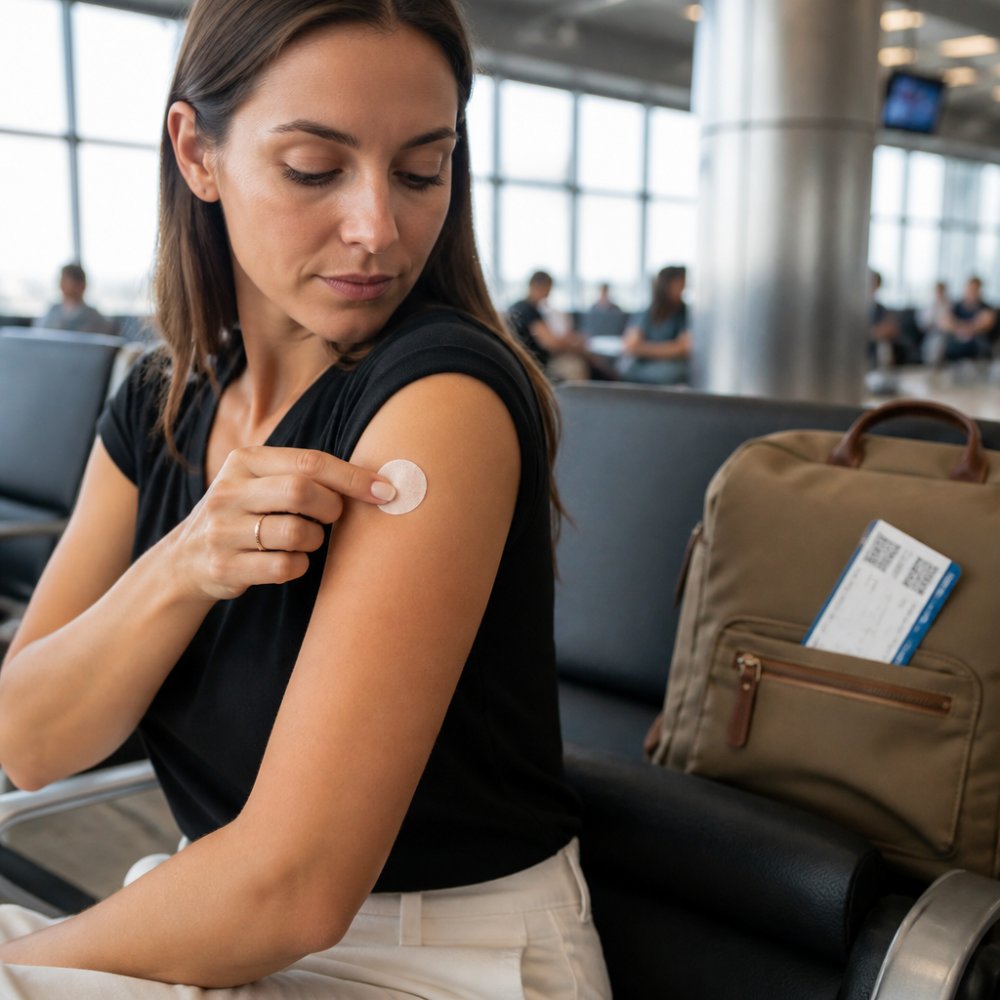
A common mistake is applying over moisturizer or sunscreen. Residue prevents adhesion, and a patch that peels at hour two delivers nothing.
Best Vitamins for Long-Haul Flights
The best vitamins for long-haul flights are the ones your body actually needs to manage disrupted sleep and energy. B-complex vitamins support energy metabolism. Vitamin C and vitamin E act as antioxidants during the oxidative stress of travel. Magnesium supports muscle relaxation and sleep quality.
| Nutrient | Role During Travel | Typical Patch Timing |
|---|---|---|
| B-complex vitamins | Energy metabolism and focus | Day |
| Vitamin C | Antioxidant support | Day |
| Vitamin E | Antioxidant support | Day |
| Melatonin | Circadian rhythm adjustment | Night |
| Magnesium | Muscle relaxation, sleep support | Night |
| Valerian root, hops | Calming support | Night |
Patches vs. the Other Travel Health Aids You Already Pack
Most travelers already carry some combination of melatonin gummies, hydration salts, electrolyte packets, and a multivitamin. Patches are not a replacement for all of them, they overlap with some and not others. Here is how the categories actually compare on a trip:
- Melatonin gummies: The closest functional equivalent to a night patch. Gummies are cheap and easy to find, but they require water, they add sugar, and dosing is fixed per piece. A night patch delivers melatonin gradually rather than in one bolus, which some travelers find gentler. Neither is a substitute for light exposure and schedule discipline.
- Hydration and electrolyte salts: These address fluid and mineral loss, which patches do not. A patch will not rehydrate you after a dehydrating flight or a bout of traveler's stomach. Pack both if you are flying long-haul or heading somewhere hot.
- Oral multivitamins: Convenient at home, awkward in transit. They need water, they can upset an empty stomach, and they deliver a single daily dose rather than a sustained one. A day patch sidesteps the water problem but covers fewer nutrients than a broad-spectrum multivitamin.
- Caffeine: Effective for short-term alertness, but it disrupts sleep if used too late in a flight and does nothing for circadian adjustment. A day patch is caffeine-free, which matters if you are trying to sleep on the second leg of a trip.
- Prescription sleep aids: A different category entirely. Patches are not a substitute, and anyone using prescription medication should talk to a clinician before layering supplements on top.
Transdermal Patch Safety and Skin Care
Watch for these issues:
- Redness or itching at the application site
- Patches that lift at the edges during sleep
- Reactions to a specific ingredient rather than the adhesive
For sensitive skin, test one patch on your inner forearm at home a few days before your trip. If you react, you find out on your couch rather than at 35,000 feet.
Comparing the Reset Jet Lag Patch System
The Reset Jet Lag Travel Patch System is a time-released, non-habit forming transdermal patch built around a Day and Night protocol. Each patch is 30mm x 30mm, ultra-thin, and discreet under clothing. The Day Patch carries B-complex vitamins, vitamin C, and vitamin E. The Night Patch carries melatonin, magnesium, hops, and valerian root.
Three pack sizes cover different travel frequencies:
| Pack | Patches Included | Price | Best For |
|---|---|---|---|
| 1 Pack | 12 (6 Day + 6 Night) | $21.99 | A single round trip |
| 2 Pack | 24 (12 Day + 12 Night) | $39.58 | Two trips or a longer stay |
| 3 Pack | 36 (18 Day + 18 Night) | $56.07 | Frequent flyers |
Frequently Asked Questions
Do transdermal vitamin patches actually work for travel?
They can help support your body's adjustment to new time zones. The transdermal delivery system bypasses the digestive system, allowing ingredients to enter the bloodstream gradually. This sustained release may help maintain steady energy levels and support sleep without the peaks and crashes of oral supplements. For travel, the main advantage is convenience and consistent delivery while you are in transit or adjusting to a new schedule.
Are transdermal patches FDA-regulated like oral supplements?
The FDA regulates transdermal patches differently depending on their claims. Patches making drug claims (like treating a disease) require approval, while those with structure/function claims are regulated as dietary supplements. Always check the label for third-party testing and consult your doctor if you have medical conditions or take medications.
What vitamins are best for combating jet lag when traveling?
For daytime energy, B-complex vitamins, vitamin C, and vitamin E are common. For nighttime sleep support, melatonin, magnesium, hops, and valerian root are frequently used. The best approach is a day-and-night protocol that supports your circadian rhythm: energizing nutrients in the morning and calming ingredients before bed. Always follow the product's usage instructions.
How do transdermal patches compare to oral vitamin supplements?
Oral supplements go through the gastrointestinal system, where absorption can vary. Transdermal patches deliver ingredients through the skin directly into the bloodstream, bypassing first-pass metabolism. This can lead to more sustained release. However, absorption rates vary by ingredient and patch design. For travel, patches offer convenience and eliminate the need for pills or water.
Can I use transdermal vitamin patches if I have sensitive skin?
Many patches use medical-grade, hypoallergenic adhesive, but skin reactions are possible. Before using a patch for the first time, test it on a small area of skin for 24 hours. If you experience redness, itching, or irritation, discontinue use. Always apply to clean, dry skin free of lotions or oils to improve adhesion and reduce irritation risk.
Jet lag costs business travelers their first productive day and costs vacationers a chunk of their trip. Reset Jet Lag built a system around that specific problem: a time-released transdermal patch with a Day and Night protocol, plant-based ingredients and vitamins, and no pills or caffeine required. The 1 Pack covers a single round trip at $21.99, and the 3 Pack brings the per-trip cost down for frequent flyers. Get started with Reset Jet Lag and land ready to work, not ready to sleep.