

Table of Contents
- Why Jet Lag Happens and What It Does to Your Body
- How to Avoid Jet Lag Naturally: Pre-Flight Sleep Adjustments
- Melatonin for Jet Lag Dosage: What the Research Shows
- In-Flight Strategies: Hydration, Caffeine, Alcohol, and Meal Timing
- Transdermal Patches for Travel Fatigue: A Non-Pill Option
- Light Exposure, Napping, and Sensory Tools for Faster Adjustment
- Common Mistakes That Make Jet Lag Worse
- Conclusion: Building Your Personal Jet Lag Plan
- Frequently Asked Questions
Last Updated: September 18, 2026
Why Jet Lag Happens and What It Does to Your Body
Jet lag is a temporary sleep disorder that happens when your internal clock falls out of sync with a new time zone. Your body runs on a roughly 24-hour circadian rhythm, and it can't reset overnight.

How to Avoid Jet Lag Naturally: Pre-Flight Sleep Adjustments
The most effective way to avoid jet lag naturally starts days before you board. Most travelers wait until they're in the air, which is too late.
Shifting Your Sleep Schedule Before Departure
Start three to four days out. For eastward trips, go to bed earlier and wake earlier. For westward trips, do the opposite.
- Eastward: move bedtime 30-60 minutes earlier each night
- Westward: push bedtime 30-60 minutes later each night
- Hold your wake time steady once you land
- Get bright light in the morning to lock in the shift
Choosing Flight Times That Work With Your Internal Clock
Arrival time shapes your whole plan. A flight that lands in the evening lets you sleep soon after. One that lands at 6 a.m. forces you to stay awake all day.
Melatonin for Jet Lag Dosage: What the Research Shows
Melatonin for jet lag dosage is one of the most searched questions, and the honest answer is that timing matters more than amount. Melatonin is a hormone your pineal gland releases in the evening to signal that night has arrived. Taken at the right hour, it can nudge your circadian clock earlier or later. Taken at the wrong hour, it can push your rhythm the wrong direction and make the mismatch worse.
Phase Advance vs. Phase Delay: A Direction-Specific Timing Chart
The direction you fly determines whether you need to pull your clock earlier (phase advance) or push it later (phase delay). Eastward travel across multiple time zones requires a phase advance, which is the harder adjustment. Westward travel requires a phase delay, which most people tolerate better because the body naturally drifts later more easily than earlier.
| Direction | Goal | When to Take Melatonin | Typical Low Dose |
|---|---|---|---|
| Eastward (e.g., U.S. to Europe) | Phase advance, sleep earlier | At target bedtime in the new time zone, for the first 2-4 nights after arrival | 0.5-3 mg |
| Westward (e.g., U.S. to Asia return) | Phase delay, sleep later | Often not needed; if used, take it in the early morning hours at destination, not at bedtime | 0.5-1 mg |
| North-south (minimal time change) | Little to no shift | Usually unnecessary | , |
A few practical notes that most guides skip:
- Take melatonin 30 to 60 minutes before the bedtime you want in the new time zone, not before the bedtime your body currently expects.
- If you wake in the middle of the night and cannot fall back asleep, do not take a second dose. It will not help and may leave you foggy in the morning.
- Melatonin is not a sedative. It works by shifting your clock, so it may not make you feel sleepy right away.
- Bright light in the morning after a melatonin dose helps lock in the new schedule. Light and melatonin work as a pair.
Who Should Skip Melatonin Without Medical Advice
Melatonin is sold as a supplement in the United States, which means it is not held to the same manufacturing standards as prescription drugs. Dose accuracy can vary between brands, so choose a product with a USP verification mark when possible.
Talk to your doctor before using melatonin if you:
- Take blood thinners, immunosuppressants, or medications for seizures
- Are pregnant or breastfeeding
- Have an autoimmune condition or a history of seizures
- Are giving it to a child, pediatric dosing is different and should be set by a clinician
In-Flight Strategies: Hydration, Caffeine, Alcohol, and Meal Timing
Dehydration makes jet lag worse, so hydration is your first in-flight job. Cabin air is dry, and you lose fluids without noticing.
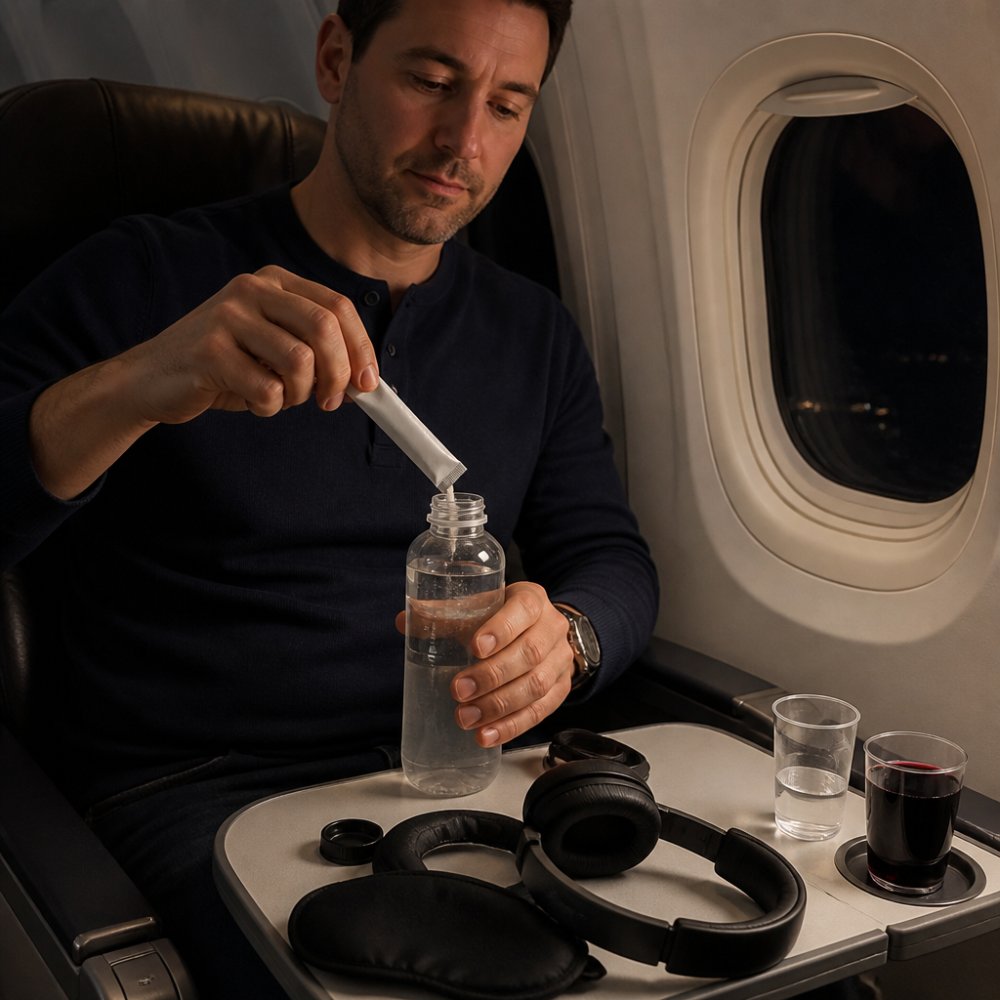
- Drink water every hour you're awake
- Limit caffeine to the first half of the flight
- Avoid alcohol entirely on long hauls
- Eat light, and time meals to your destination
Transdermal Patches for Travel Fatigue: A Non-Pill Option
Transdermal patches for travel fatigue offer a pill-free way to support your rhythm. They deliver vitamins and plant-based extracts through the skin over several hours.
Reset Jet Lag Travel Patch System - 1 →
| Patch | Key Ingredients | When to Wear | Best For |
|---|---|---|---|
| Day Patch | B-complex, Vitamin C, Vitamin E | Morning | Energy and focus |
| Night Patch | Melatonin, Magnesium, Hops, Valerian Root | Bedtime | Sleep support |
Light Exposure, Napping, and Sensory Tools for Faster Adjustment
Daylight is the single strongest natural signal for resetting your internal clock. Your brain reads bright light as daytime and uses it to anchor the circadian rhythm. The trick is that the timing of that light has to match the direction you flew, morning light helps on some trips and hurts on others.
Direction-Specific Light Timing
For eastward travel, where you need to phase advance, get bright light in the morning at your destination. Step outside within an hour of waking, even for 15 to 30 minutes, and avoid bright light in the late evening, which will push your clock the wrong way.
Napping Without Stealing Your Night Sleep
Napping needs a light touch. A short 20-minute nap takes the edge off fatigue without cutting into the sleep pressure you need at bedtime. Set an alarm, because a nap that drifts past 30 minutes can leave you groggy and make it harder to fall asleep that night.
A few patterns that work well:
- Nap before 3 p.m. local time so you are tired again by evening.
- Keep the room bright or semi-lit so you do not slip into deep sleep.
- Use a 20-minute timer, not a "I'll wake up when I feel rested" approach.
- If you cannot sleep at night after a nap, shorten the next one rather than skipping sleep entirely.
Non-Pharmacological Sensory Tools
Beyond light, the tools that help most are the ones that reduce competing signals so your body can rest on schedule. This is the category most jet lag guides skip, and it is where a small kit pays off.
- Blue-light blocking glasses. Wearing amber or red-tinted lenses in the two to three hours before bed reduces the blue light that suppresses melatonin. They are most useful on the first evening after an eastward flight, when you want your body to start producing melatonin earlier than it expects.
- Noise-canceling headphones. Cabin noise and hotel noise both fragment sleep. Over-ear noise-canceling headphones or well-fitted foam earplugs raise sleep quality on the plane and at the hotel, which matters more on a two- or three-night trip than on a long vacation.
- Contoured sleep mask. A mask that blocks light completely helps you sleep during daylight hours at your destination, which is often the only window you have to nap on schedule.
- Grounding and barefoot time outdoors. Walking barefoot on grass, sand, or a balcony for 10 to 15 minutes combines morning light exposure with gentle movement, which helps regulate body temperature and supports the circadian signal. It is not a cure on its own, but it stacks with the light protocol above.
- Cool, dark, quiet room. Keep the hotel room cool, most sleep clinicians suggest the mid-60s Fahrenheit, and use the mask and earplugs together rather than relying on one.
A Simple First-24-Hours Checklist
- On arrival, get outside within an hour if you landed in the morning after an eastward flight.
- If you landed in the evening after a westward flight, stay in bright light until a normal local bedtime.
- Nap only if you must, and cap it at 20 minutes before 3 p.m.
- Wear blue-light blockers in the two hours before bed.
- Use a mask and earplugs to protect whatever sleep window you have.
- Dim the room in the evening and keep it cool.
Common Mistakes That Make Jet Lag Worse
A few habits quietly undo your best efforts. The biggest mistake is arriving and fighting the local clock instead of adapting to it.
- Staying up all day on caffeine instead of sleeping on schedule
- Taking melatonin at the wrong time of day
- Drinking alcohol to fall asleep on the plane
- Napping for hours right after landing
Conclusion: Building Your Personal Jet Lag Plan
Jet lag hits hardest when you leave recovery to chance. A simple plan, built around light, sleep timing, and hydration, changes how you land.
Frequently Asked Questions
What is the fastest natural way to get over jet lag?
The fastest natural approach combines light exposure with sleep timing. Get outside in morning daylight at your destination to signal your internal clock, and avoid bright light in the evening. Melatonin taken at the right local time can help reset your sleep-wake cycle. Staying hydrated and eating meals on the local schedule also speeds recovery. Most travelers adjust within one day per time zone crossed when they follow these steps consistently.
Does melatonin actually help with jet lag?
Research supports melatonin as one of the most effective natural remedies for jet lag, particularly for eastward travel. A typical melatonin for jet lag dosage is 0.5 to 5 mg taken 30 to 60 minutes before target bedtime at your destination. Lower doses often work as well as higher ones with fewer side effects. Timing matters more than dose: taking it at the wrong hour can shift your internal clock in the wrong direction.
How can I adjust my sleep schedule before a trip?
Start three to four days before departure. For eastward trips, go to bed and wake up 30 to 60 minutes earlier each day. For westward trips, push bedtime later by the same amount. Pair the shift with morning light exposure to reinforce the change. If your schedule does not allow a gradual shift, prioritize getting solid sleep the night before so you start the trip without sleep deprivation.
Are transdermal patches for travel fatigue safe for sensitive skin?
Transdermal patches for travel fatigue use medical-grade, hypoallergenic adhesive designed for sensitive skin. Apply to clean, dry skin free of lotions or oils. If you have known allergies or take medications, check the ingredient list with your doctor first. Patches are non-habit forming and deliver ingredients gradually, which some travelers prefer over pills. Remove after the recommended wear time and rotate application sites.