

Table of Contents
- Why Sleep During Long Haul Flights Is So Hard
- The Pre-Flight Protocol: How to Adjust to New Time Zones Before You Board
- In-Flight Sleep Strategy: Seat, Light, and Temperature Control
- Best Sleep Aids for Long Flights (That Won't Leave You Groggy)
- Tips for Traveling with Kids Internationally: Sleep Edition
- Post-Flight Recovery: What to Do in the First 24 Hours
- Common Mistakes That Wreck Long Haul Sleep
- Conclusion
- Frequently Asked Questions
Last Updated: September 15, 2026
Why Sleep During Long Haul Flights Is So Hard
Managing sleep during long haul flights is difficult because your body fights physics, biology, and cabin design at once, which is why managing sleep during long haul travel demands a full protocol. At cruising altitude, cabin pressure sits lower than at sea level, humidity drops sharply, and your circadian rhythm has no idea what time it is. This guide from Reset Jet Lag breaks down a complete protocol: pre-flight preparation, in-flight execution, and post-flight recovery.

Restorative sleep depends on stable body temperature, low ambient light, and quiet. A long haul cabin delivers none of those, and with dehydration and cramped economy seating, sleep latency stretches from minutes into hours.
What most guides miss: the flight is only one variable. Your sleep schedule for the two days before departure matters just as much.
The Pre-Flight Protocol: How to Adjust to New Time Zones Before You Board
Start shifting your sleep schedule three days before departure, moving bedtime 30 to 60 minutes per day toward your destination's clock. How to adjust to new time zones comes down to consistency, not willpower.
A few pre-flight habits that do the heavy lifting:
- Set your watch to the destination time zone the moment you book
- Get bright morning light exposure at your target wake time
- Avoid alcohol for 48 hours before departure
- Pack a sleep amenity kit: eye mask, earplugs, compression socks, neck pillow
- Stop caffeine intake 8 hours before your planned in-flight sleep window
The CDC guidance on jet lag and travel recommends timed light exposure as a primary tool for time zone adjustment. Sleep hygiene before you fly is the foundation everything else rests on.
In-Flight Sleep Strategy: Seat, Light, and Temperature Control
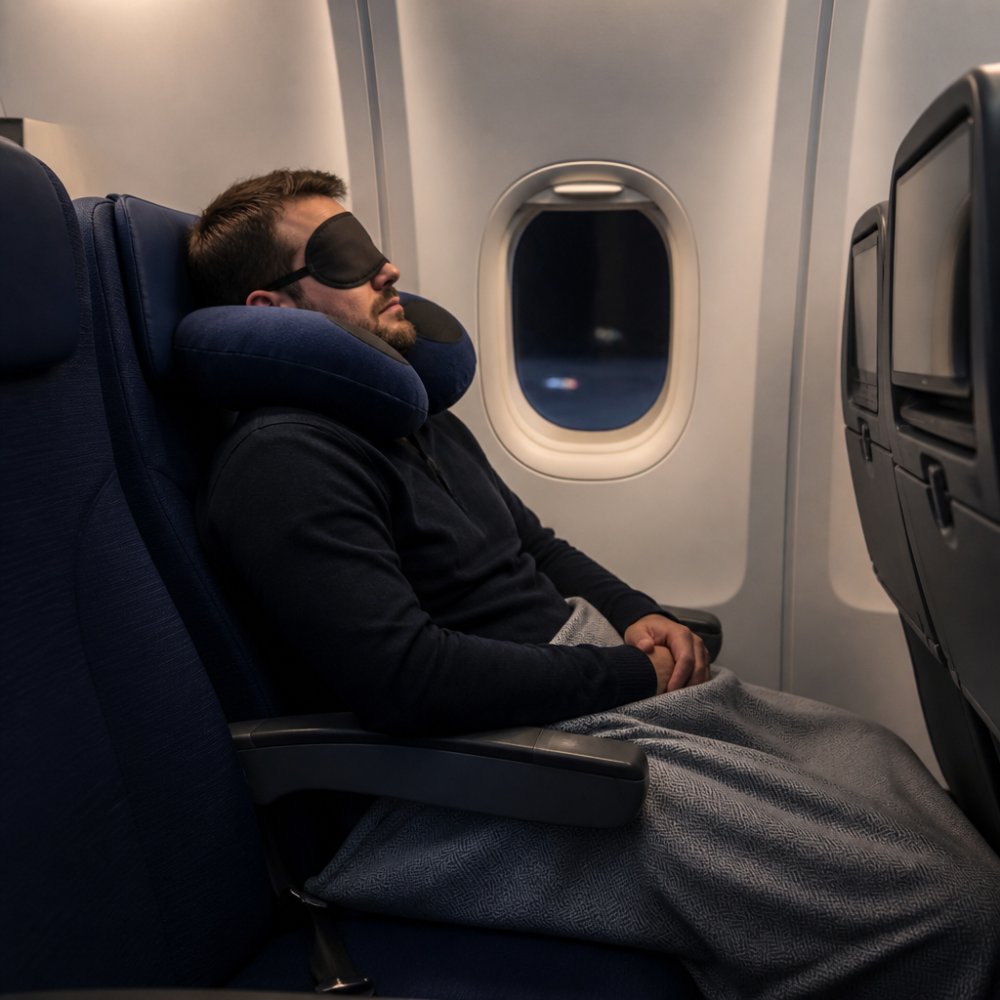
The best in-flight sleep strategy is controlling four variables: seat position, ambient light, noise, and body temperature. Get those right and deep sleep becomes possible even in economy.
Seat Selection and Recline Tactics
Window seats win for sleep because you control the shade and never get bumped by aisle traffic. Avoid the middle seat entirely on overnight legs. Recline early, before meal service, so you're not fighting for it later. Strategic planning for choosing a window seat ensures you secure the necessary solitude for uninterrupted rest during your journey.
Managing Cabin Pressure, Hydration, and Body Temperature
Cabin pressure mimics roughly 6,000 to 8,000 feet of elevation, which mildly dehydrates you. Drink water steadily, skip the wine, and layer clothing so you can adjust as body temperature drops. Compression socks help circulation during long immobility.
Best Sleep Aids for Long Flights (That Won't Leave You Groggy)
The best sleep aids for long flights support your circadian rhythm instead of forcing sedation. The goal is to fall asleep on your destination's clock and wake without a hangover at 30,000 feet, which rules out much of what travelers reach for by default.
Melatonin: Timing Matters More Than Dose
Melatonin is a timing signal, not a sedative. Taken at the wrong hour, it can shift your clock the wrong way and worsen jet lag. Frequent flyers often take a low dose, 0.5 mg to 3 mg, 30 to 60 minutes before the target sleep window in the destination time zone, not the departure zone. Higher doses aren't more effective and tend to increase next-day grogginess and vivid dreams.
Two practical rules:
- Take it at the destination's bedtime, even if that feels early or late to your body.
- If you wake up in the middle of the flight, do not take a second dose to "top up." You will land foggy.
Prescription and OTC Sedatives: Higher Risk Than Most Travelers Realize
OTC sleep aids built on antihistamines (diphenhydramine, doxylamine) and prescription sedatives (zolpidem, eszopiclone, benzodiazepines) do put you to sleep, but they suppress the deep and REM stages your body needs to recover. On a long haul flight the trade-off is worse than it sounds: sedatives raise the risk of immobility-related issues like blood clots and can leave you impaired for hours after landing, a real problem if you're driving or making decisions on arrival.
Medical Contraindications: When to Skip Sleep Aids Entirely
This part matters more than any dosing chart.
- Pregnancy and breastfeeding. Melatonin crosses the placenta and passes into breast milk. Most practitioners advise against routine use without a clinician's sign-off.
- Autoimmune conditions. Melatonin can interact with immune-modulating medications and, in some people, flare symptoms.
- Thyroid conditions. Melatonin can affect thyroid hormone signaling; if you take levothyroxine or similar, timing and dose need a clinician's input.
- Anticoagulants and antiplatelets. Melatonin may modestly affect clotting; combined with the immobility of a long flight, this is worth a conversation with your prescriber.
- Sedatives plus alcohol. Never combine them, in the air or on the ground. The respiratory depression risk is real.
- Children. Melatonin use in kids should be clinician-directed, not parent-guessed, especially across multiple time zones.
- Epilepsy, depression, and bipolar disorder. Melatonin can interact with mood and seizure thresholds in some patients.
A Comparison That Actually Helps You Choose
| Option | Mechanism | Best For | Watch Out For |
|---|---|---|---|
| Melatonin, low dose | Timing signal for circadian shift | Eastbound and westbound trips where you can time the dose | Wrong-hour dosing makes jet lag worse; contraindicated in pregnancy and some conditions |
| Transdermal melatonin patch | Slow, steady release through skin | Multi-day trips and travelers who dislike pills | Requires planning; skin sensitivity in some users |
| Antihistamine sleep aids | Sedation via H1 blockade | Rare, one-off use | Next-day fog, anticholinergic effects, not for older adults |
| Prescription sedatives | CNS depression | Almost never the right call for a flight | Dependency, immobility risk, impairment on arrival |
| Behavioral only (light, timing, temperature) | Circadian entrainment | Light sleepers, pregnant travelers, anyone on interacting meds | Slower adaptation, requires discipline |
Non-Pharmacological Aids That Pull Their Weight
- Blue-light-blocking glasses worn 2 to 3 hours before your target sleep window.
- Cabin noise control, foam earplugs plus over-ear headphones beat either alone.
- A consistent pre-sleep ritual you already use at home: same eye mask, same breathing pattern, same playlist.
- Cooling your body, a light layer you can shed, plus a cool drink of water, nudges core temperature down, which is a sleep-onset signal.
The safest and most effective in-flight sleep aid is usually a correctly timed low-dose melatonin plus light, noise, and temperature control. Sedatives are a last resort, not a default, and for some travelers, the right answer is no pharmacological aid at all.
Tips for Traveling with Kids Internationally: Sleep Edition
Tips for traveling with kids internationally start with one rule: keep their sleep schedule as close to normal as possible during transit. Children adapt faster when the routine stays consistent.
Bring a familiar blanket, a white noise app, and an eye mask sized for kids. Feed them on the destination's schedule, not the departure city's. For adults and children alike, a non-habit-forming patch avoids the tolerance issues that make parents wary of repeated melatonin use.
Post-Flight Recovery: What to Do in the First 24 Hours
Most guides stop at landing.
Hours 0-2: Land, Light, and Hydrate
Hours 2-6: Anchor to the Local Clock
Hours 6-12: The Danger Window
Hours 12-24: Protect the First Night's Sleep
What Not to Do in the First 24 Hours
Arrival day is not recovery day, it is the most important day of the protocol. Light, hydration, meal timing, and a short-nap cap do more for jet lag than anything you do on the plane.
Common Mistakes That Wreck Long Haul Sleep
A few recurring errors undo everything:
Conclusion
Frequently Asked Questions
What can I do to help me sleep better on long haul flights?
Start adjusting your sleep schedule 2-3 days before departure by shifting bedtime 30-60 minutes toward your destination's time zone. On board, use an eye mask, noise-canceling headphones, and a neck pillow. Avoid caffeine after the first two hours of flight, drink water every hour, and keep your seat reclined with a light blanket to maintain body temperature. A transdermal patch system like Reset Jet Lag can support your circadian rhythm without pills or caffeine.
How do transdermal patches help with circadian rhythm adjustment?
Transdermal patches deliver ingredients gradually through the skin. This steady release supports your body's natural sleep-wake cycle without the spike-and-crash of pills. The Reset Jet Lag system uses a day patch with vitamins and a night patch with melatonin and valerian root. It is non-habit forming and designed for time zone adjustment during long haul travel.
What are the best sleep aids for long flights?
The best sleep aids for long flights are non-habit forming and address both sleep latency and circadian rhythm. Options include melatonin (timed-release), magnesium, valerian root, and transdermal patches that combine these ingredients. Reset Jet Lag's night patch contains melatonin, magnesium, hops, and valerian root. Avoid prescription sedatives unless approved by your doctor, as they can cause grogginess and interact with other medications.
How can I manage jet lag when traveling with kids internationally?
For tips for traveling with kids internationally, start shifting their sleep schedule 3-4 days before the trip by 30 minutes daily. On the plane, keep them hydrated, use eye masks and small neck pillows, and avoid sugary snacks. Book a night flight if possible to align with their natural sleep window. After arrival, get everyone outside in natural light within the first hour to reset circadian rhythm. A non-habit forming patch system can help both adults and children over 18 adjust faster.