

Table of Contents
- Why Shift Work Makes Sleep So Hard (and What Actually Helps)
- How We Ranked the Top 5 Natural Sleep Aids for Shift Workers
- 1. Reset Jet Lag Travel Patch System: Best Overall Natural Sleep Aid for Shift Workers
- 2. Melatonin for Shift Work Timing: The Most Studied Natural Sleep Aid
- 3. Magnesium, L-Theanine, and Valerian Root: Relaxation Without Next-Day Grogginess
- 4. Shift Work Sleep Disorder Treatment: When Natural Aids Are Not Enough
- 5. Daytime Sleep Tips for Night-Shift Workers: Light, Environment, and Routine
- Which Natural Sleep Aid Fits Your Shift Pattern?
- Frequently Asked Questions
Last Updated: October 12, 2026
Why Shift Work Makes Sleep So Hard (and What Actually Helps)
Night shift workers face a biological mismatch no amount of willpower can fix. Your circadian rhythm releases melatonin when it gets dark, so clocking in at 11 p.m. and sleeping at 8 a.m. means fighting evolution.
We hear from nurses, flight crews, and factory workers who have tried everything. The problem is rarely discipline. It is timing.
Shift work sleep disorder is a recognized condition in which the work schedule and the body clock stay permanently out of sync. According to the National Institute for Occupational Safety and Health shift work resources, irregular schedules affect millions of workers and raise the risk of fatigue-related errors.
What helps is a two-part approach: support the body clock with well-timed natural sleep aids, and control the light and environment around your daytime sleep.
How We Ranked the Top 5 Natural Sleep Aids for Shift Workers
We judged every option on five criteria: evidence quality, fit with a rotating or night schedule, next-day grogginess risk, safety and interactions, and ease of use. A supplement that works for a 9-to-5 sleeper can fail for someone sleeping at 9 a.m.
Here is how the five picks compare at a glance:
| Aid | Best For | Timing | Main Trade-Off |
|---|---|---|---|
| Reset Jet Lag Patch System | Best overall, full day-night support | Day patch on waking, night patch before bed | Patch must be applied to clean, dry skin |
| Melatonin | Most studied, fastest sleep onset | 30-60 min before target sleep | Wrong timing shifts your clock the wrong way |
| Magnesium | Muscle relaxation, gentle support | 30-60 min before bed | Loose stools at high doses |
| L-Theanine | Calm alertness without sedation | 30-60 min before sleep | Subtle effect on its own |
| Valerian Root | Long-term sleep quality support | 30-120 min before bed | Needs consistent nightly use |
1. Reset Jet Lag Travel Patch System: Best Overall Natural Sleep Aid for Shift Workers
Our top pick is the Reset Jet Lag Travel Patch System because it solves the hardest problem in shift work sleep: supporting both awake and sleep hours with one protocol.

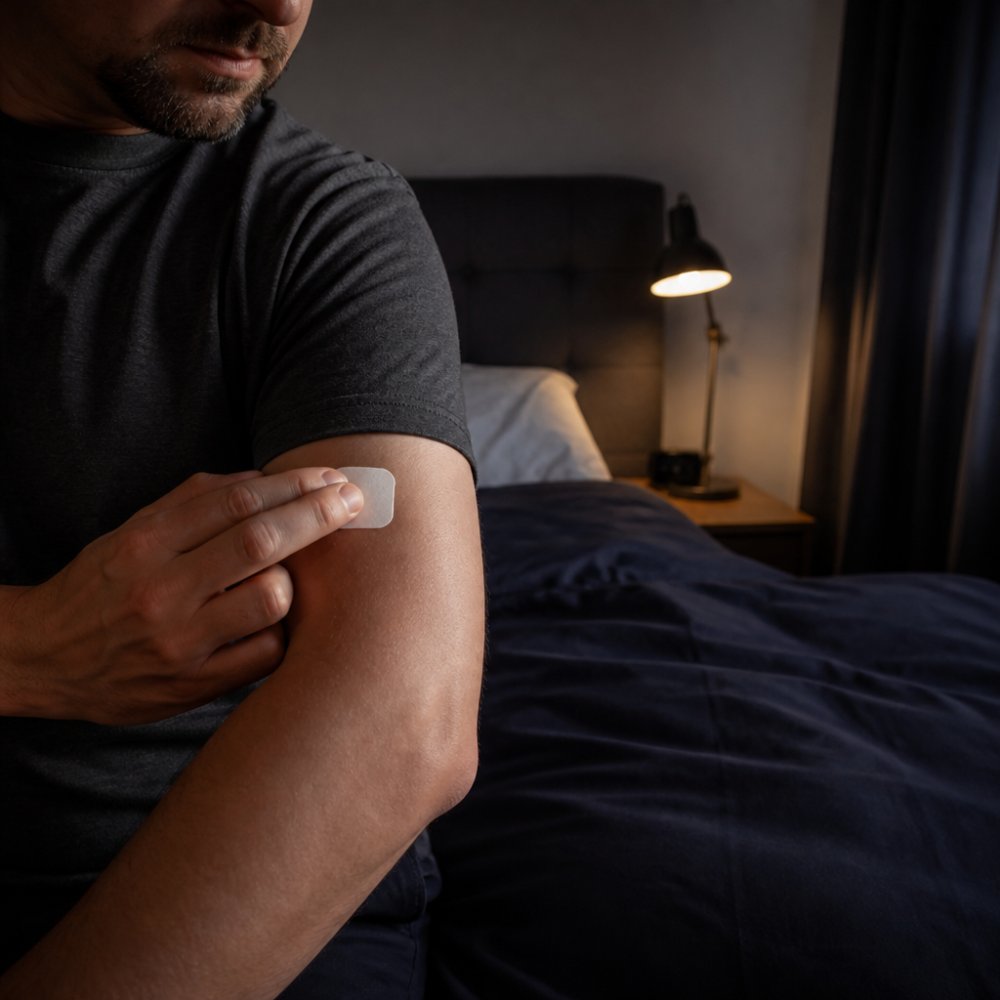
Each 30mm x 30mm patch is ultra-thin and discreet under clothing.
(/collections/all-products) only address the sleep side, leaving you to white-knuckle a 3 a.m. shift on caffeine.The system is non-habit forming, contains no pills or caffeine, and uses plant-based ingredients and vitamins.
Pricing: a 1 Pack with 12 patches (6 Day + 6 Night) is $21.99, a 2 Pack with 24 patches is $39.58, and a 3 Pack with 36 patches is $56.07.
2. Melatonin for Shift Work Timing: The Most Studied Natural Sleep Aid
Melatonin is the most researched natural sleep aid on this list, and the most misused. It is a hormone your pineal gland produces to signal darkness and sleep onset. Taken at the right time it nudges your body clock toward a new schedule; taken at the wrong time it pushes your rhythm further out of alignment, which is why timing, not dose, matters most.
What the Evidence Actually Shows
The Cochrane review of melatonin for shift workers found that melatonin can increase sleep duration for people working irregular schedules, though effects on overall sleep quality are modest. That is a realistic picture: helpful, not magic. The research quality varies, many studies are small, use different doses, and measure sleep differently, so treat melatonin as a reliable nudge for sleep timing rather than a guaranteed fix for daytime sleep.
How to Time Melatonin for Daytime Sleep
The rule is simple. Take melatonin 30 to 60 minutes before your target sleep time, not before you leave work. If your shift ends at 7 a.m. and you want to be asleep by 8:30 a.m., take it around 7:30 a.m.
Timing by shift pattern:
- Permanent night shift: Take it at the same clock time every morning before your daytime sleep block. Consistency trains the clock faster than any single dose.
- Rotating shifts: Take it only on the days you are transitioning into a night block, about 30 to 60 minutes before your first daytime sleep. Skip it on days off to avoid drifting your rhythm further.
- Switching back to a day schedule: A low dose taken in the early evening for two or three nights can help advance your clock, but keep the dose small and the timing consistent.
Dosing: Lower Is Often Better
Typical study doses range from 0.5 mg to 5 mg, and lower doses often work as well as higher ones for shifting the body clock. Many practitioners start at 0.5 mg to 1 mg and only increase if needed. Higher doses do not reliably improve sleep and may increase next-day grogginess, a real problem when your "morning" is 6 p.m.
Safety, Interactions, and Next-Day Impairment
Melatonin is generally well tolerated but not risk-free:
- Interactions: It can interact with blood thinners, immunosuppressants, anticonvulsants, and some blood pressure medications. Check with a pharmacist first.
- Health conditions: People with autoimmune conditions, seizure disorders, or liver disease should talk to a clinician first.
- Next-day impairment: Because melatonin can leave some people drowsy, avoid driving or heavy machinery for the first few hours after waking until you know how it affects you.
3. Magnesium, L-Theanine, and Valerian Root: Relaxation Without Next-Day Grogginess
These three round out the list because they support relaxation without the sedation that leaves you foggy when the alarm goes off, which matters when your "morning" is 6 p.m. But they are not interchangeable, and the evidence behind each is not equally strong.
Magnesium: Gentle Nervous-System Support
Magnesium helps regulate the nervous system and muscle relaxation.
Evidence quality: Moderate for general relaxation and sleep quality, weaker for sleep onset. Most studies look at older adults or people with deficiency, not shift workers.
Shift-work timing: Take it 30 to 60 minutes before your daytime sleep block.
Watch for: People with kidney disease should not take magnesium without medical guidance.
L-Theanine: Calm Without Sedation
L-Theanine is an amino acid found in tea that promotes calm alertness rather than drowsiness, useful if you want to feel settled without being knocked out.
Evidence quality: Modest. Small studies suggest it can improve relaxation and sleep quality, but the research is limited and effects are subtle.
Reset Jet Lag Travel Patch System - 1 Pack (12 Patches) →
Shift-work timing: Take it 30 to 60 minutes before sleep.
Watch for: It is generally well tolerated. If you take blood pressure medication, check with a pharmacist, as it may have a mild lowering effect.
Valerian Root: Long-Term Sleep Quality Support
Valerian root has a long history of use for sleep quality. The National Center for Complementary and Integrative Health overview of valerian notes that evidence for valerian is mixed, with some studies showing modest improvements in sleep.
Evidence quality: Mixed. Some trials show modest benefit for sleep latency and quality; others show no difference from placebo. Results vary by preparation and dose.
Shift-work timing: Take it 30 to 120 minutes before bed.
Watch for: Valerian can cause drowsiness, so avoid driving or machinery until you know how it affects you. It may interact with sedatives, antidepressants, and liver-metabolized medications.
How to Choose Among the Three
| Aid | Best For | Typical Dose | Timing | Evidence Strength |
|---|---|---|---|---|
| Magnesium glycinate | Muscle relaxation, gentle support | 200-400 mg | 30-60 min before sleep | Moderate |
| L-Theanine | Calm without sedation | 100-200 mg | 30-60 min before sleep | Modest |
| Valerian root | Long-term sleep quality | Follow product label | 30-120 min before bed | Mixed |
For shift workers, these are supporting players, not headliners, and work best alongside a structured schedule and light control. For faster sleep onset, melatonin is more direct. To take the edge off without next-day fog, L-theanine is gentlest. For a modest payoff with consistent use, valerian root is worth a trial. Integrating these options into a broader strategy helps maintain circadian stability, though exploring a wider range of supplements for shift workers can provide additional support for those struggling with persistent irregular hours.
4. Shift Work Sleep Disorder Treatment: When Natural Aids Are Not Enough
Natural sleep aids have a ceiling. If you have tried timed melatonin, a solid sleep environment, and consistent scheduling for several weeks and are still exhausted, the problem may need clinical attention.
Shift work sleep disorder treatment typically starts with a doctor.
The American Academy of Sleep Medicine maintains resources for finding a board-certified sleep specialist.
Natural aids are not a substitute for diagnosis. They are the first line, and a good one. They are not the only line.
5. Daytime Sleep Tips for Night-Shift Workers: Light, Environment, and Routine
No supplement outperforms a bad sleep environment. If sunlight streams through your bedroom window at 9 a.m. while you try to sleep, you are working against your own biology.
Light Exposure and Blackout Strategies
Light is the most powerful signal your body clock responds to. Use it deliberately in both directions.
- Wear sunglasses on the commute home to limit morning light before sleep
- Use blackout curtains or a quality sleep mask to keep the bedroom dark
- Get bright light at the start of your shift to signal wakefulness
For sound, ear plugs or a white noise machine block daytime noise. Keep the room cool, since core body temperature must drop for sleep onset.
A consistent sleep schedule matters just as much. Go to bed and wake at the same times on work days, keep those times close on days off, and use a short routine to train your brain to expect sleep at that hour.
Which Natural Sleep Aid Fits Your Shift Pattern?
Match the aid to your schedule, not the other way around. A permanent night shift worker has different needs than someone on rotating or split shifts.
| Shift Pattern | Best Primary Aid | Supporting Options |
|---|---|---|
| Permanent night shift | Reset Jet Lag Patch System | Magnesium, blackout curtains |
| Rotating shifts | Melatonin (timed) | L-Theanine, light control |
| Early morning shift | Magnesium | Valerian root, sleep mask |
| Split or on-call schedule | Reset Jet Lag Patch System | L-Theanine, ear plugs |
For faster sleep onset, melatonin is the most direct tool. For better sleep quality over time, valerian root and magnesium are worth a consistent trial.
Shift work sleep problems rarely have a single fix.
Frequently Asked Questions
What is the best sleep aid for shift workers?
The best option depends on your shift pattern and sleep goal. For a non-habit-forming, pill-free approach, the Reset Jet Lag Travel Patch System combines a Day Patch with B-complex vitamins and a Night Patch with melatonin, magnesium, hops, and valerian root. For those who prefer oral supplements, timed melatonin remains the most studied natural sleep aid for shift workers. Magnesium and L-theanine can support relaxation without next-day grogginess.
When should shift workers take melatonin?
Timing matters more than dose. For a night-shift worker who needs to sleep during the day, take melatonin 30 to 60 minutes before your planned daytime sleep, not before your shift. A typical dose is 0.5 to 3 mg. Taking it too early or too late can shift your body clock the wrong way and worsen sleep onset latency. Pair it with a dark, quiet sleep environment for best results.
How is shift work sleep disorder treated?
Shift work sleep disorder treatment often starts with behavioral changes: a consistent sleep schedule, light exposure management, and a dark, cool sleep environment. Natural sleep aids like melatonin, magnesium, or valerian root may help with sleep onset. If symptoms like excessive sleepiness or insomnia persist for more than a month, a doctor may recommend prescription options or cognitive behavioral therapy for insomnia. Always check with a healthcare provider before combining supplements with medications.
Are natural sleep aids safe to use regularly?
Most natural sleep aids are considered safe for short-term use, but regular use depends on the ingredient. Melatonin is generally well tolerated at low doses, though long-term data is limited. Valerian root and passionflower may interact with sedatives or antidepressants. Magnesium can cause digestive upset at high doses. The Reset Jet Lag patch is non-habit forming. Check with your doctor if you take prescription medications.
What can shift workers try besides supplements to improve sleep?
Light exposure is the most powerful tool. Wear sunglasses on your commute home if you need daytime sleep, and seek bright light at the start of your shift. Use blackout curtains, a sleep mask, and ear plugs to create a dark, quiet sleep environment. Keep your sleep schedule consistent even on days off. A wind-down routine with dim lighting and no screens for 30 minutes before bed can also improve sleep quality without any supplement.