

Table of Contents
- Why Business Travel Wrecks Your Sleep (and What It Costs You)
- How to Beat Jet Lag Naturally Before You Board
- Best Natural Sleep Aids for Travel (Ranked by What They Do)
- Hotel Room Sleep Hygiene Tips That Actually Work
- What to Eat and Drink (and Skip) on Travel Days
- Tech That Tracks Your Sleep on the Road
- Your Post-Trip Recovery Protocol
- Frequently Asked Questions
Last Updated: September 23, 2026
Why Business Travel Wrecks Your Sleep (and What It Costs You)
Natural sleep solutions for business travel start with one hard truth: your body runs on a clock, and a plane can reset it in hours. Cross three time zones and your internal rhythm lags behind. You land alert at 2 a.m. body time and foggy at your 9 a.m. meeting.
How to Beat Jet Lag Naturally Before You Board
The best time to fight jet lag is before you fly. Start adjusting your schedule three days out, use light on the plane, and time your meals to your destination. This is the foundation of any natural sleep plan, and meal timing is the lever most travelers ignore.

Shift Your Schedule Three Days Out
Move your bedtime 30 to 60 minutes toward your destination's time each night. If you're flying east, go to bed earlier. Flying west, stay up later.
Time Your Meals to Your Destination
Your gut runs on its own clock, and meal timing is one of the strongest signals you can send to reset it. The strategy is simple: eat on your destination's schedule, not your body's, starting the day before you fly.
- Flying east (you will lose hours): Eat your last full meal earlier than usual the night before. On the plane, skip the meal service if it lands during your destination's night, and eat when it is morning there.
- Flying west (you will gain hours): Eat a normal or slightly later dinner the night before. On the plane, eat when it is mealtime at your destination even if you are not hungry.
- The fasting window: A common approach is to stop eating 12 to 16 hours before your target breakfast time at the destination, then break the fast with a protein-forward meal in morning light. This pairs the fasting signal with the light signal, which is how the two clocks sync.
- Hydration: Cabin air is dry, and dehydration worsens fatigue. Drink water throughout the flight. Go easy on caffeine and alcohol, both of which disrupt sleep quality.
Time Your Light Exposure on the Plane
Light tells your brain what time it is. Use it on purpose.
- Flying east: seek light in the morning at your destination, avoid it in the evening.
- Flying west: get afternoon and evening light, dim things in the morning.
- On the plane, close the shade when it's "night" at your destination.
- Skip the caffeine. It masks fatigue without fixing your clock.
The Night Before You Fly
- Pack your sleep kit so you are not hunting for earplugs at 11 p.m. in a hotel.
- Set your bedtime 30 to 60 minutes earlier or later, depending on direction.
- Eat your last full meal at least two to three hours before bed.
- Skip alcohol. It fragments sleep in the second half of the night.
- Charge your phone and load a white noise app.
The travelers who beat jet lag are not the ones with the best genetics. They are the ones who started three days early and used light, food, and timing together.
Best Natural Sleep Aids for Travel (Ranked by What They Do)
The best natural sleep aids for travel fall into three groups: ones that help you sleep, ones that relax your muscles, and ones that calm your mind. Match the aid to your actual problem.
Melatonin, Magnesium Glycinate, and L-Theanine
- Melatonin: signals your brain that it's nighttime. Best for shifting your clock, not knocking you out.
- Magnesium glycinate: supports muscle relaxation and is easy on the stomach.
- L-Theanine: an amino acid that promotes calm without drowsiness.
Transdermal Patches vs. Pills and Gummies
Pills and gummies hit fast and fade fast. Patches deliver steadily through the skin. That steady release matters when you want support for hours, not a spike.
| Format | Onset | Duration | Best For |
|---|---|---|---|
| Pills | Fast | Short | Quick sleep onset |
| Gummies | Fast | Short | Easy dosing |
| Transdermal patches | Gradual | Long | All-day and all-night support |
Hotel Room Sleep Hygiene Tips That Actually Work
Hotel room sleep hygiene tips come down to three things: cool, dark, and quiet. But a hotel room is not your bedroom, and the generic advice stops working the moment you walk into a room with a glowing thermostat, a hallway ice machine, and curtains that leave a six-inch light gap. Here is how to actually hack the room. Mastering these environmental adjustments ensures you wake up refreshed, which is essential when you need to maintain focus without caffeine throughout the following day.
The 15-Minute Hotel Room Reset
Do these in order the moment you drop your bag. Total time is about 15 minutes.
- Thermostat: Set it to 65-68°F. Most hotel thermostats are locked to a range, so if 65°F is not available, drop it to the lowest setting and turn the fan to "on" rather than "auto" so air keeps moving. A cooler room supports the core body temperature drop that precedes sleep onset.
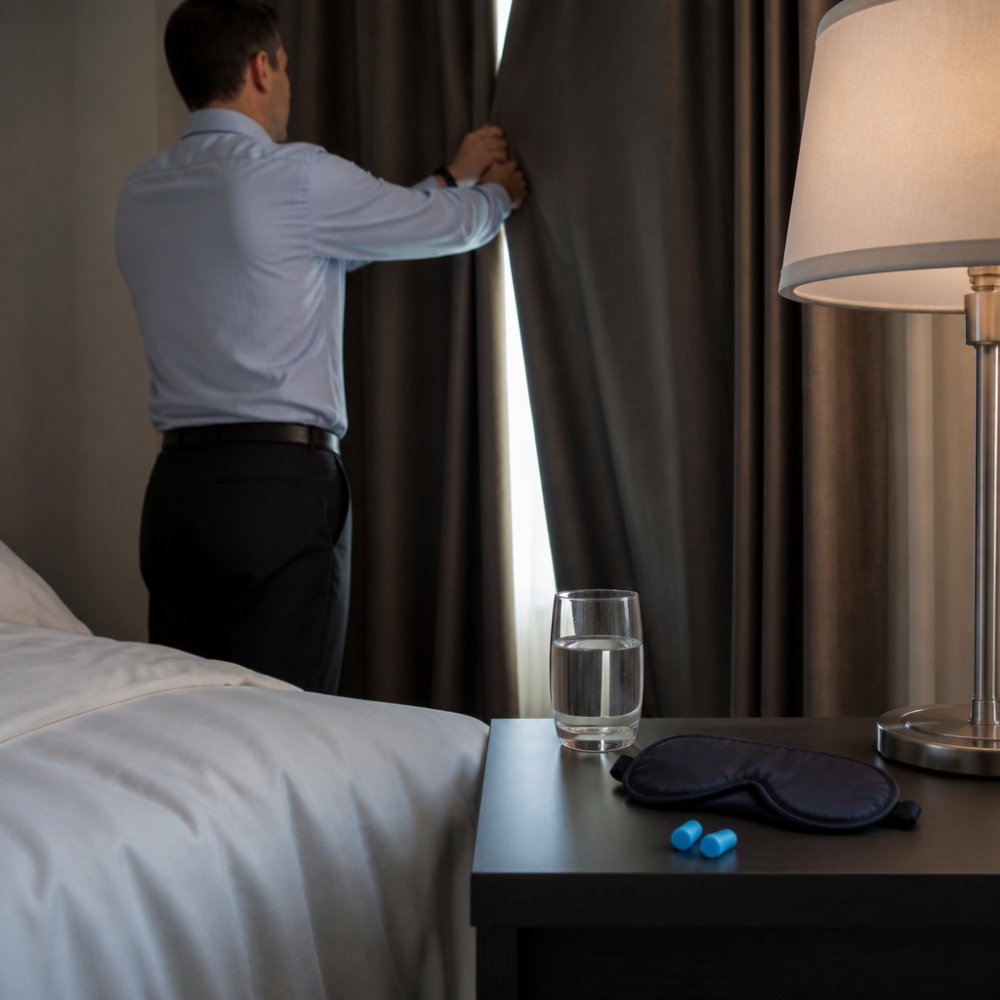
- Curtains: Pull blackout curtains fully closed, then clip the center seam with a chip clip or binder clip from your bag. Hotels rarely seal the middle gap, and that seam is where streetlight and hallway light leak in.
- Light audit: Unplug or turn face-down the alarm clock, the TV standby light, and any charging indicator. Unplug the bedside lamp if it has a touch-sensitive base that glows. If a smoke detector or thermostat LED is bright, cover it with a piece of painter's tape or a bandage from your kit.
- Sound: Run a white noise app or a small travel sound machine. Aim for steady, low-frequency noise, not rain or nature loops that change. Steady noise masks the two biggest hotel disruptions: hallway doors and the ice machine.
- Door gap: Roll a towel and push it against the bottom of the door. This blocks both light and hallway noise.
- Allergens: If you are sensitive, ask the front desk for an allergy-friendly or pillow-protector room, or bring a travel pillowcase. Hotel bedding is washed in industrial detergent, and duvets are often not changed between guests.
What to Pack for the Room
A small sleep kit earns its space in a carry-on:
- Eye mask (contoured, not flat, so it does not press on your eyes)
- Foam earplugs plus one pair of over-ear or noise-masking earbuds
- Two chip clips or binder clips for the curtain seam
- A few feet of painter's tape for LEDs
- A travel sound machine or a phone loaded with a white noise app
- Your own pillowcase if you are picky about texture
What to Eat and Drink (and Skip) on Travel Days
Dietary timing matters as much as light. Eat on your destination's schedule, even if you're not hungry. Your gut clock follows your meals.
- Skip heavy, greasy meals before a long flight.
- Avoid alcohol, which fragments sleep.
- Limit caffeine after early afternoon at your destination.
- Carry electrolyte packets to replenish what travel drains.
Tech That Tracks Your Sleep on the Road
Sleep trackers turn guesswork into data. A wearable can show how long it took you to fall asleep, how often you woke, and how your rhythm shifted. That feedback tells you whether your plan is working.
Your Post-Trip Recovery Protocol
Most guides stop at the flight. Recovery is where the real gains hide. The first 48 hours home decide whether you bounce back or drag for a week.
- Get morning sunlight on day one, no matter how tired you are.
- Keep meals on local time.
- Avoid long naps. Cap them at 20 minutes.
- Move your body, even a short walk helps.
- Stay on your normal bedtime.
Frequently Asked Questions
What is the best natural sleep aid to take during airline travel?
It depends on whether you want to sleep or stay alert. For rest on an overnight flight, magnesium glycinate and L-theanine support muscle relaxation without the next-day fog that some sleep aids cause. For arrival-day focus, B-complex vitamins and vitamin C help maintain energy. A transdermal patch system like Reset Jet Lag splits the difference: a Day Patch with B-complex, vitamin C, and vitamin E, and a Night Patch with melatonin, magnesium, hops, and valerian root. Apply each for up to 8 hours, then remove.
How can I manage jet lag naturally during business trips?
Start three days before departure by shifting your bedtime 30 to 60 minutes toward your destination's schedule. On the plane, time your light exposure: seek sunlight in the morning if you are flying east, and in the afternoon if flying west. Stay hydrated with an electrolyte mix, skip alcohol, and keep meals light. Once you land, get outside during daylight hours and avoid napping longer than 20 minutes. These natural sleep solutions for business travel reduce the grogginess that costs you the first day of meetings.
Are transdermal patches effective for sleep regulation while traveling?
Transdermal patches deliver ingredients gradually through the skin, which some travelers prefer over pills that hit all at once. The Reset Jet Lag system uses a Day and Night protocol: the Day Patch contains B-complex vitamins, vitamin C, and vitamin E; the Night Patch contains melatonin, magnesium, hops, and valerian root. Each patch is 30mm x 30mm, ultra-thin, and worn for up to 8 hours. The gradual delivery may help maintain a steadier effect, though individual results vary.
How do I overcome travel insomnia in a hotel room?
Treat the room like a sleep lab. Set the thermostat between 65 and 68 degrees Fahrenheit, close blackout curtains, and use earplugs or a white noise app to mask hallway noise. Keep lights dim for the hour before bed and put your phone on Do Not Disturb. If you wake at 3 a.m., avoid checking the time; instead, use a relaxation technique like 4-7-8 breathing. A Night Patch with melatonin and magnesium can support your circadian rhythm without leaving you groggy for the morning meeting.
Business travel doesn't have to cost you your first two days. The fix is a plan: shift your schedule early, use light with intent, set up your hotel room, and recover on purpose.
Reset Jet Lag makes that plan simple. Our non-habit-forming patch system delivers plant-based ingredients and vitamins through the skin, with a Day Patch for focus and a Night Patch for rest. No pills, no caffeine, no grogginess.
Get started with Reset Jet Lag and land ready to work, not just ready to sleep.