

Table of Contents
- What Is a Jet Lag Patch and How Does It Work?
- Transdermal Vitamin Patch Efficacy: What the Evidence Shows
- Melatonin for Jet Lag Prevention: Does It Actually Help?
- How to Use Jet Lag Patches: A Step-by-Step Protocol
- Key Ingredients in Travel Patches: Day vs. Night Formulas
- Contraindications and Drug Interactions to Know Before You Buy
- Comparing Patch Types: What to Look For in a Jet Lag Patch
- Verdict: Does Jet Lag Patch Work for Your Travel Needs?
- Frequently Asked Questions
Last Updated: September 23, 2026
What Is a Jet Lag Patch and How Does It Work?
A jet lag patch is a small transdermal sticker worn on the skin that releases ingredients such as melatonin, B vitamins, or plant extracts over several hours. The goal is to support the body's sleep-wake cycle during time zone adjustment, without pills or caffeine.
The Science Behind Transdermal Delivery
Transdermal delivery means an ingredient passes through the skin and into the bloodstream. It is the same route used by nicotine and hormone patches, which have decades of clinical use behind them.
Transdermal Vitamin Patch Efficacy: What the Evidence Shows
The evidence for transdermal patches is mixed and depends heavily on which ingredient you are asking about. Melatonin has the strongest research base. Vitamins are murkier.
The Skin Barrier Problem
Human skin is built to keep things out. The outer layer, the stratum corneum, is a brick-and-mortar wall of dead cells packed in lipid. For a molecule to reach the bloodstream, it has to dissolve through that lipid matrix, then cross the living epidermis and dermis to reach capillaries.
- Molecular size. Smaller molecules cross more easily. Melatonin is a small molecule (roughly 232 daltons), which puts it in a range the skin can plausibly absorb. Many vitamins are far larger.
- Lipid solubility. Fat-soluble molecules partition into the skin's lipid barrier more readily than water-soluble ones. Vitamin C is water-soluble, which is one reason transdermal vitamin C is a much harder sell than transdermal melatonin.
- Dose required. A molecule that crosses skin at a low rate can still work if the effective dose is small. Melatonin's effective dose is measured in fractions of a milligram, so even modest permeation can matter. Vitamins are often dosed in milligrams to grams, which is a much higher bar.
Bioavailability vs. Oral Supplements
Bioavailability describes how much of an ingredient actually reaches your bloodstream. Oral supplements pass through the digestive system, where absorption varies. Transdermal delivery bypasses digestion entirely, which is the theoretical advantage.
Clinical Trials and Placebo Effect
Jet lag research has a placebo problem. If you expect a patch to help, you may sleep better regardless of what is in it. That does not mean patches are useless. It means personal experience is weak evidence. Rigorous clinical scrutiny remains the only way to distinguish genuine physiological benefits from the psychological comfort provided by various natural sleep aids.
Melatonin for Jet Lag Prevention: Does It Actually Help?
Melatonin for jet lag prevention has the best supporting evidence of any ingredient in this category. Melatonin is a hormone your body releases in the evening to signal that sleep is coming.
The most common mistake is taking melatonin on the plane at your home time zone instead of your destination's evening. Shift your dosing toward the destination's clock a day before you fly.
How to Use Jet Lag Patches: A Step-by-Step Protocol
Using jet lag patches well comes down to timing, not quantity. Here is the protocol we recommend, and the one our Day and Night system is built around.
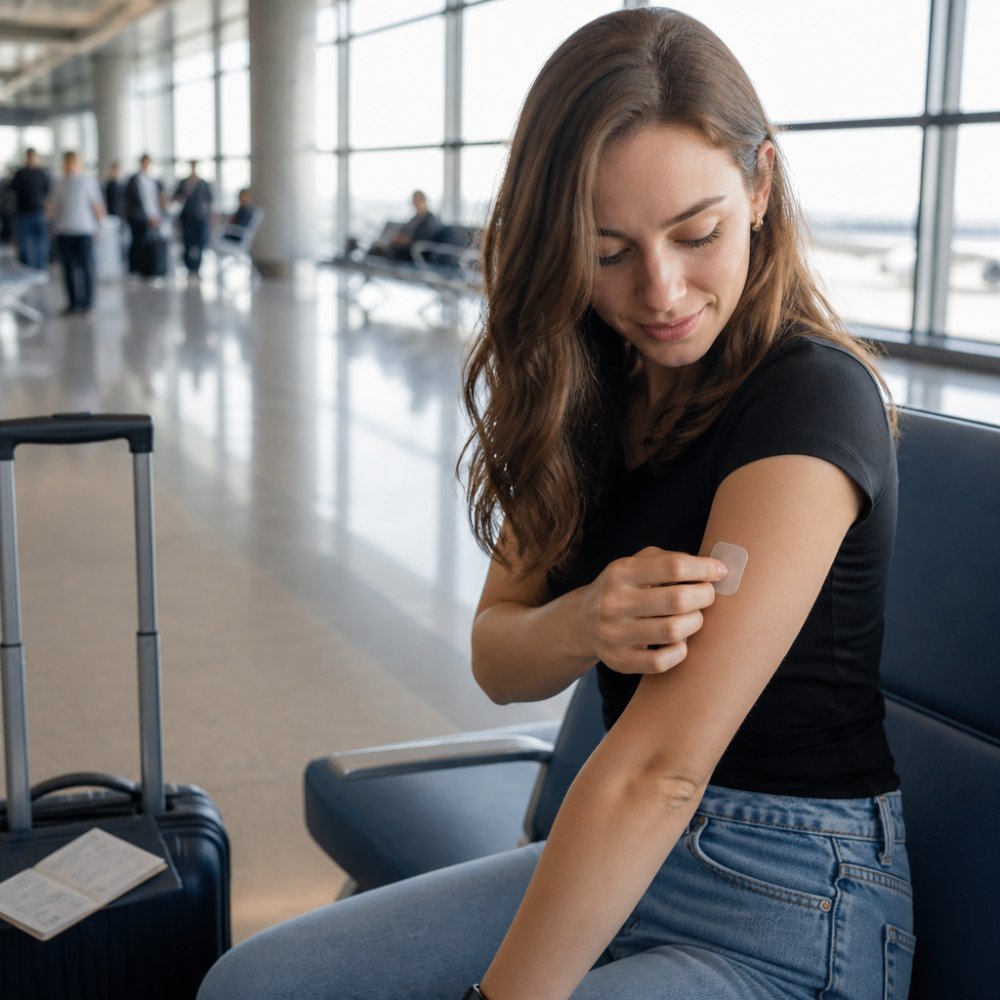
- Set your schedule to the destination clock 24 hours before departure. Eat and sleep on the new rhythm as soon as you can.
- Apply the Day patch in the morning, local destination time. Wear it for up to 8 hours, then remove it.
- Apply the Night patch before bedtime, destination time. Wear it for up to 8 hours, then remove it.
- Clean and dry the skin first. Lotions and oils stop the patch from adhering properly.
- Rotate application sites. Move the patch to a different spot each time to avoid irritation.
- Keep going for two to three nights after arrival. One patch will not reset a rhythm.
Key Ingredients in Travel Patches: Day vs. Night Formulas
Travel patch formulas split into two jobs: keep you alert during the day and help you wind down at night. The ingredient list tells you which job a patch is doing.
| Formula | Typical Ingredients | Purpose | Wear Time |
|---|---|---|---|
| Day patch | B-complex vitamins, vitamin C, vitamin E | Support energy and focus | Up to 8 hours |
| Night patch | Melatonin, magnesium, hops, valerian root | Support sleep onset | Up to 8 hours |
Contraindications and Drug Interactions to Know Before You Buy
Contraindications and interactions are the part most patch reviews skip, and it is the part that matters most. Melatonin interacts with blood thinners, immunosuppressants, and some epilepsy medications. Valerian root can amplify sedatives and anti-anxiety drugs.
Comparing Patch Types: What to Look For in a Jet Lag Patch
Not all patches are built the same, and the differences decide whether yours stays on through a long-haul flight. But before you compare brands, compare categories. Travel patches split into two functional jobs, and they are not interchangeable.
Energy Patches vs. Sleep Patches
| Feature | Energy patch | Sleep patch |
|---|---|---|
| Typical actives | B-complex vitamins, caffeine, vitamin C | Melatonin, magnesium, valerian root, hops |
| Job | Support daytime alertness | Support sleep onset at the destination's night |
| Timing | Morning, destination time | Before bed, destination time |
| Evidence strength | Weak for transdermal vitamins; caffeine is better studied orally | Strongest for melatonin |
| Main risk | Overlapping with coffee or other stimulants | Stacking with sedatives or a second melatonin dose |
The two categories are doing opposite things, so a single "all-purpose" patch that claims to both wake you up and wind you down is a red flag. No formula can push your circadian rhythm in two directions at once.
What Separates a Good Patch From a Cheap One
Once you know which category you need, the physical build decides whether the patch works in practice:
- Adhesive quality. Medical-grade, hypoallergenic adhesive holds through sweating and showering. Cheap adhesive peels within hours, which means the active ingredient stops delivering.
- Breathable backing. A flexible, breathable backing keeps the skin comfortable during long wear and reduces irritation.
- Discreet size. A 30mm x 30mm patch sits flat under clothing and stays out of sight.
- Separate day and night formulas. A single "all-purpose" patch cannot both wake you up and wind you down.
- Clear dosing. Look for named ingredients and wear times, not vague "proprietary blends."
Reading the Label Like a Skeptic
A short, honest label beats a crowded one. Two patterns are worth watching for:
- The kitchen-sink formula. A patch listing twenty ingredients with no amounts is usually relying on the appearance of coverage rather than a meaningful dose of any single active.
- The borrowed-halo claim. A brand may cite melatonin research to sell a patch whose main ingredient is a B vitamin. The evidence does not transfer between ingredients.
Verdict: Does Jet Lag Patch Work for Your Travel Needs?
For travelers who want a pill-free, caffeine-free option, a jet lag patch is a reasonable tool, and melatonin-based night patches have the best evidence behind them. Day patches are more about supporting focus than performing a dramatic shift.
Frequently Asked Questions
Do jet lag patches work?
Jet lag patches deliver ingredients like melatonin and B-complex vitamins through the skin. How well they work depends on the formulation and your body's response. Transdermal delivery bypasses the digestive system, which some travelers find more consistent than oral supplements. The Reset Jet Lag system uses a day-and-night protocol with separate patches for energy and sleep support. Results vary by person, but the approach targets circadian rhythm adjustment rather than masking symptoms.
Are transdermal vitamin patches safe for frequent travelers?
Transdermal vitamin patch efficacy and safety depend on the ingredients. The Reset Jet Lag patches use medical-grade, hypoallergenic adhesive and plant-based ingredients like melatonin, magnesium, hops, and valerian root. They are non-habit forming and caffeine-free. If you have sensitive skin or take medications, check with your doctor first. The patches are designed for up to 8 hours of wear, so remove them before applying a new one.
How do transdermal patches deliver nutrients compared to oral supplements?
Transdermal delivery moves ingredients through the skin and into the bloodstream, avoiding first-pass metabolism in the liver. This can mean better bioavailability for some compounds. Oral melatonin, for example, is broken down quickly by the digestive system. A patch releases ingredients gradually over several hours, which may better support a steady sleep-wake cycle adjustment. That said, absorption rates vary based on skin type, placement, and formulation.
How long does one jet lag patch last, and how many do I need per trip?
Each Reset Jet Lag patch is worn for up to 8 hours. The system includes separate Day and Night patches. For a typical international trip, you would use one Day Patch each morning and one Night Patch before bed. A 1-pack contains 12 patches (6 Day + 6 Night), which covers about 6 days. The 2-pack has 24 patches, and the 3-pack has 36 patches for longer trips or multiple journeys.
Can I use melatonin for jet lag prevention if I've had bad reactions to sleep aids before?
Melatonin for jet lag prevention works differently than prescription sleep aids. It is a hormone your body already produces to signal sleep time. The Reset Jet Lag Night Patch combines melatonin with magnesium, hops, and valerian root. It is non-habit forming. If you have had grogginess with oral melatonin, a transdermal patch may release a lower, steadier dose. Still, start with one patch at home before relying on it during a trip.
Jet lag is one of the few travel problems you can actually plan around, and the planning is where most people give up. Reset Jet Lag makes that part easier with a time-released transdermal patch system, a clear Day and Night protocol, and non-habit-forming, plant-based ingredients you can pack without a second thought. Get started with Reset Jet Lag and land ready to work, not recovering.