

Table of Contents
- Why the Best Travel Tips for Business Start Before You Book
- How to Manage Jet Lag for Business Trips
- The Business Travel Packing List That Saves Hours
- Optimizing Airports and Transit for Maximum Productivity
- Travel Risk Management and Duty of Care for Teams
- Tips for Traveling with Kids Internationally
- Bleisure, Digital Nomad Taxes, and Sustainable Travel
- Conclusion
- Frequently Asked Questions
Last Updated: September 30, 2026
Why the Best Travel Tips for Business Start Before You Book
The best travel tips for business begin long before you reach the airport. They start with the booking decision itself. This guide from Reset Jet Lag breaks down what actually protects your energy, focus, and schedule on the road.

Most professionals treat travel as dead time. That is a costly mistake. A poorly timed red-eye can wipe out your first day of meetings. A badly planned itinerary can leave you foggy for a keynote you spent months preparing for.
Below, we cover the strategies that matter most, from flight timing to packing to jet lag recovery. The 8 sections ahead give you a full system you can use on your next trip.
The Real Cost of Poorly Planned Business Travel
Poor planning shows up in ways that are easy to miss. You land tired, so you skip the prep call. You book a connection that leaves no buffer, so a delay snowballs. You pack late, so you forget the charger you need for your presentation.
Many companies find that travel-related fatigue and scheduling errors quietly drain productivity. The fix is not more travel. It is better travel.
A few habits separate smooth trips from chaotic ones:
- Book flights that match your natural sleep window
- Build in buffer time between connections
- Confirm entry requirements and visa rules early
- Share your itinerary with someone at home and at work
- Pack the night before, not the morning of
How to Manage Jet Lag for Business Trips
Managing jet lag for business trips comes down to timing, light, and a consistent day-and-night routine. The goal is to shift your body clock before it drags your performance down.
Timing Your Flights and Light Exposure
Light is the strongest signal your body uses to reset its clock. Get morning light at your destination to push your rhythm forward. Get evening light to push it back.
A common mistake is arriving and immediately napping in a dark room. That tells your body it is still night. Instead, stay awake, get outside, and let daylight do its work.
A Day-and-Night Protocol Without Pills or Caffeine
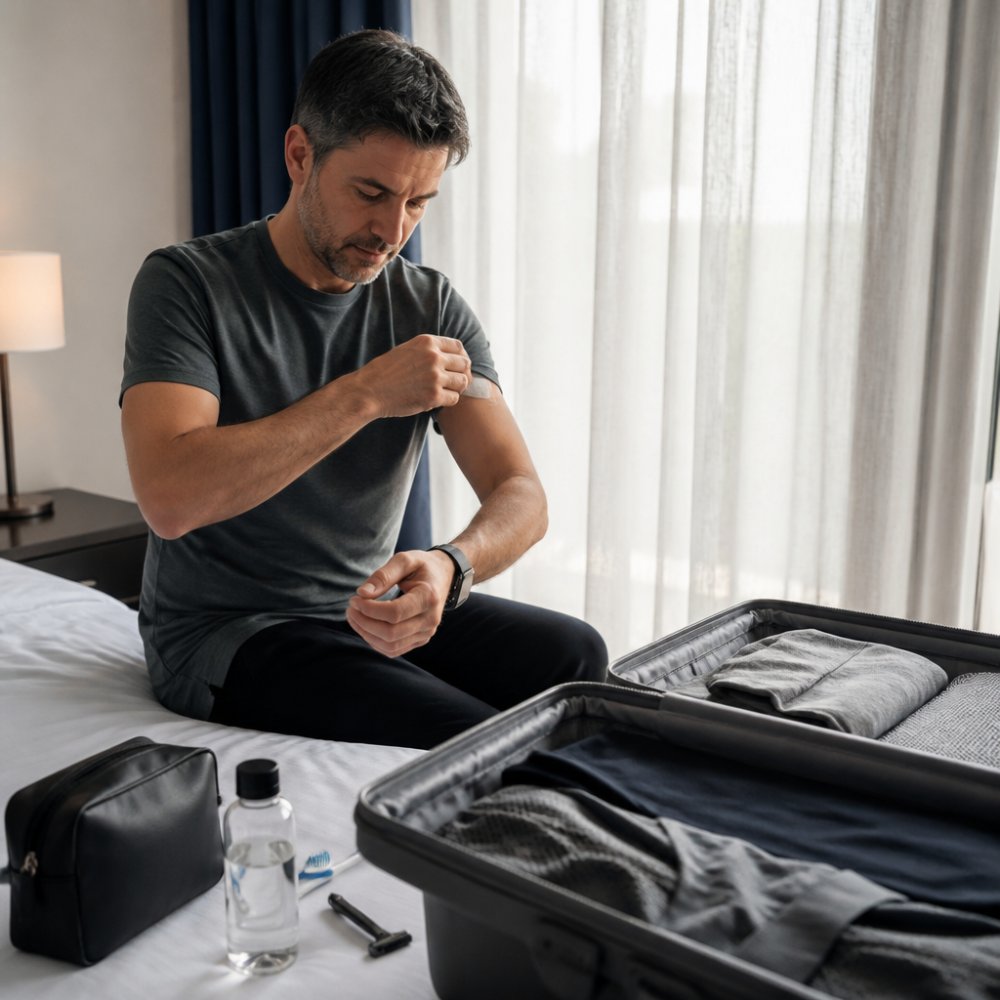
A structured day-and-night routine helps your body adjust without relying on stimulants or sleep aids. Reset Jet Lag makes a transdermal patch system built around this idea. The Day Patch includes B-complex vitamins, Vitamin C, and Vitamin E. The Night Patch includes melatonin, magnesium, hops, and valerian root.
You apply one Day Patch in the morning and one Night Patch before bed. Each patch is worn for up to 8 hours. The system is non-habit forming and delivers ingredients through the skin.
The Business Travel Packing List That Saves Hours
A tight business travel packing list saves time at the airport and stress at the hotel. The trick is to pack for the trip you are actually taking, not the one you might imagine. The goal is a single carry-on that clears security fast and still covers three days of meetings.
- Two wrinkle-resistant shirts or blouses (merino wool, wool-blend, or high-twist cotton)
- One blazer that works for meetings and dinner
- One pair of dark trousers or a dark skirt that hides travel creases
- Comfortable shoes you can walk in, plus one packable pair for the meeting room
- A universal power adapter with USB-C and USB-A ports
- A compact charger and cable pouch
- Travel-size toiletries in a clear quart-size bag
- Printed copies of key documents and a backup of your passport photo
Wrinkle-Resistant Fabrics and Packing Cubes
Wrinkle-resistant fabrics and packing cubes are the two changes that make the biggest difference. Roll your clothes instead of folding them flat. Use packing cubes to keep categories separate so you can find things fast.
Carry-On-Only Strategy and Security Mechanics
Carry-on only is the single biggest time saver on a short business trip. It removes the checked-bag carousel, the lost-luggage risk, and the 45-minute buffer most travelers build around baggage claim.
A few mechanics that matter:
ReFuel Travel Recovery and Electrolyte →
- Liquids must be 3.4 ounces (100 ml) or less per container and fit in one clear quart-size bag under current TSA rules.
- Laptops generally come out of the bag at standard screening, but TSA PreCheck lanes usually let you leave shoes, belt, and light jacket on and keep the laptop in the bag.
- A bag that fits under the seat in front of you is faster than one that goes in the overhead bin, because you skip the boarding-group scramble.
- Wear your heaviest shoes and jacket on the plane to save bag space.
Optimizing Airports and Transit for Maximum Productivity
Airport time is not lost time if you plan it. Travel efficiency comes from knowing your airport, your lounge options, and your backup plan before you arrive.
A few moves that help:
- Check in the night before and download boarding passes
- Use TSA PreCheck or a trusted traveler program where available
- Find your gate first, then settle in
- Carry a laptop-friendly bag that fits under the seat
- Keep a portable charger on you, not in checked luggage
Travel Risk Management and Duty of Care for Teams
Travel risk management is the process of identifying and reducing the risks your team faces on the road. Duty of care is the legal and ethical obligation to protect them.
For companies, this means:
- Tracking where employees are during trips
- Sharing travel safety protocols before departure
- Confirming travel insurance and health coverage
- Setting a clear check-in schedule
- Having an emergency contact chain
U.S. State Department international travel guidance
Tips for Traveling with Kids Internationally
Traveling with kids internationally adds a layer of logistics that business travelers rarely plan for. The same principles apply, but the timeline stretches.
Bleisure, Digital Nomad Taxes, and Sustainable Travel
Bleisure trips mix business and leisure, and they come with tax questions most travel guides skip. If you extend a work trip for personal days, the personal portion is generally not deductible. The IRS treats travel expenses as deductible only when they are ordinary, necessary, and directly tied to carrying on a trade or business, so a Saturday at the beach is not a business expense even if the flight was.
IRS guidance on business travel expenses
The Digital Nomad Tax Question
Digital nomads face a bigger question: where do you owe tax? For a U.S. citizen or resident, the answer starts with the fact that worldwide income is taxable regardless of where you sit. The foreign earned income exclusion can reduce that bill if you meet a physical-presence or bona fide-residence test, but the thresholds and the qualifying-period rules are specific and change.
Sustainable Corporate Travel
Sustainable corporate travel is moving up the agenda because many companies now report emissions alongside spend. The practical levers are well known:
- Book direct flights. Takeoff and landing burn the most fuel, so one long leg usually beats two short ones.
- Choose trains for short routes where rail is available and time-competitive.
- Combine two trips into one instead of flying the same route twice in a month.
- Pick airlines that publish a modern fleet and use sustainable aviation fuel on the route when it is offered.
- Build a virtual-first default into policy: if the meeting can be done on video, do not fly.
Conclusion
Business travel does not have to cost you your first day on the ground. With better booking, smarter packing, and a real jet lag plan, you can land ready to work.
Frequently Asked Questions
What are the best ways to manage jet lag on business trips?
Adjust your schedule to the destination time zone two to three days before departure. On the flight, hydrate and time your sleep to match local night. A day-and-night patch system like Reset Jet Lag delivers B-complex vitamins in the morning and melatonin, magnesium, hops, and valerian root at night through the skin, supporting your body's rhythm without pills or caffeine. Get morning light at your destination and avoid long naps on arrival day.
What should go on a business travel packing list?
Start with wrinkle-resistant fabrics and packing cubes to keep suits and shirts flat. Add a universal power adapter, portable charger, laptop stand, and a refillable water bottle. Pack an electrolyte mix like ReFuel for long flights. Include travel documentation, a printed itinerary, and any visa paperwork. Keep one carry-on with a change of clothes in case checked luggage is delayed.
Can I write off travel as a business expense?
Ordinary and necessary business travel expenses are generally deductible, including airfare, lodging, and meals, per IRS guidelines. Keep receipts and a log of the business purpose for each trip. Personal side trips or bleisure days are not deductible unless the primary purpose is business. Consult a tax professional for your specific situation, especially if you mix work and leisure travel.
How do I stay productive while traveling for business?
Block your calendar around flight times and use airport lounge access for focused work. Download documents offline before departure so spotty Wi-Fi does not stall you. Use travel apps for itinerary management and expense reporting. Schedule meetings for your peak energy hours at the destination, not immediately after landing. A hydration and sleep protocol helps you arrive sharp instead of foggy.