

Table of Contents
- Why the Worst Days of Jet Lag Happen
- Jet Lag Symptoms Day by Day: What to Expect
- How Long Does Jet Lag Last After Travel
- Eastbound vs. Westbound: Which Direction Hits Harder
- How to Reset Your Circadian Rhythm After Travel
- How to Get Over Jet Lag Faster: Proven Strategies
- Frequently Asked Questions
Last Updated: October 11, 2026
Why the Worst Days of Jet Lag Happen
The worst days jet lag hits hardest is when your body's internal clock doesn't match your destination's time. Your circadian rhythm controls when you sleep, eat, and feel alert.
Your body shifts about one hour per day, so a five-hour time difference takes roughly five days to resolve.
Understanding when the worst days of jet lag happen helps you plan recovery time strategically and maintain productivity during peak fatigue days.
Jet Lag Symptoms Day by Day: What to Expect
Days 1-2: Acute Disorientation
Your first two days bring confusion and fatigue. You'll feel foggy, disoriented, and emotionally flat as your body runs on home-time while your environment operates on destination-time.
Common symptoms include:
- Difficulty concentrating or making decisions
- Mild headaches or body aches
- Emotional numbness or irritability
These early days feel manageable, but starting your adjustment protocol on day one prevents the deeper crash that arrives on days three and four.
Days 3-4: Peak Fatigue and Cognitive Fog
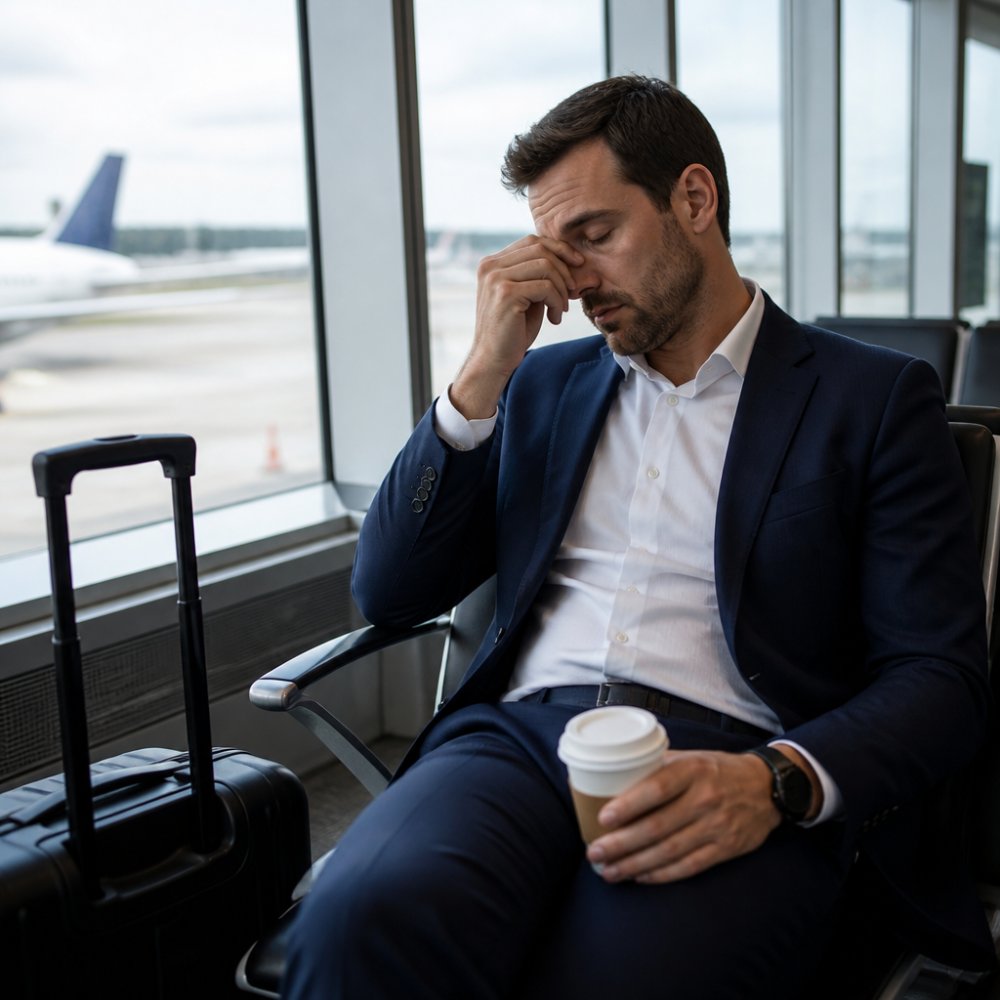
Days three and four bring the worst days of jet lag, when your body has partially shifted but remains fundamentally misaligned. You'll experience profound fatigue, sluggish thinking, and difficult decision-making. Maintaining cognitive clarity during this transition requires deliberate effort toward preventing mental fatigue, a challenge that remains critical even as your internal clock slowly begins to recalibrate.
Peak symptoms include:
- Overwhelming daytime sleepiness
- Severe difficulty concentrating
- Slower reaction times and impaired judgment
Business travelers schedule important meetings for day five or later because the worst days of jet lag impair productivity and judgment significantly.
Days 5-7: Gradual Recovery Begins
By day five, the worst days jet lag have passed and your circadian rhythm starts aligning with your destination. Fatigue decreases, cognitive function improves, and sleep becomes more aligned with local time.
The worst days of jet lag have passed by day five. You're not fully adjusted, but you're functional again. Most people feel substantially better by day seven.
How Long Does Jet Lag Last After Travel
Expect one day of recovery per hour of time-zone difference. A six-hour flight typically requires six days for full adjustment, though this varies by travel direction, age, and individual factors. Most people feel substantially functional by day five or six. The worst days of jet lag, days three and four, represent the peak of this adjustment window.
Eastbound vs. Westbound: Which Direction Hits Harder
The worst days of jet lag hit harder when you fly eastbound because your body must compress its day (fall asleep earlier) rather than extend it. Eastbound travel typically takes longer to recover from than westbound (How To Travel the World Without Jet lag). A westbound eight-hour flight might feel easier than an eastbound six-hour flight.
How to Reset Your Circadian Rhythm After Travel
Resetting your circadian rhythm requires coordinated timing across light exposure, sleep, meals, and activity. Rather than applying strategies in isolation, the most effective approach sequences them over your first five to seven days based on your travel direction and trip length.
Sample Reset Schedule: Eastbound Travel (6-Hour Time Difference)
Pre-Departure (2-3 days before flight)
- Shift bedtime 1 hour earlier each night and eat breakfast 1 hour earlier to prime your body for the eastbound shift.
Flight Day
- Set watch to destination time and eat meals on destination schedule.
- Sleep 8+ hours before arrival if it aligns with destination nighttime.
- Avoid alcohol, limit caffeine to the first half of flight, and hydrate consistently.
Day 1 (Arrival Day)
- Get 20-30 minutes of bright natural light within 1 hour of waking.
- Eat meals on destination times; light movement and outdoor time; avoid napping.
- Dim lights after sunset and avoid screens 1 hour before bed.
Days 2-3 (Peak Adjustment)
- Repeat 20-30 minute bright light exposure and maintain consistent wake time (7-8 AM local).
- Continue destination meal times and light exercise; avoid napping.
Days 3-4 (Worst Days, Expect Peak Fatigue)
- Continue morning light exposure and eat on local schedule.
- Schedule low-stakes tasks; delay critical decisions.
- Maintain consistent bedtime; avoid alcohol and napping.
Days 5-7 (Recovery Phase)
- Continue morning light for 2-3 more days; sleep consolidates and appetite normalizes.
- Return to normal schedule; most people feel functional by day 5.
Sample Reset Schedule: Westbound Travel (6-Hour Time Difference)
Pre-Departure (2-3 days before flight)
- Shift bedtime 1 hour later each night and eat dinner 1 hour later to prime your body for the westbound shift.
Flight Day
- Upon boarding: Set watch to destination time
- During flight: Eat meals on destination schedule
- First 6-8 hours: Stay awake if possible; avoid sleeping early
Day 1 (Arrival Day)
- Avoid bright light in the morning; get 20-30 minutes of bright natural light between 4-7 PM.
- Eat on destination times; light movement; avoid napping.
Days 2-3 (Adjustment Phase)
- Repeat bright light exposure (4-7 PM window) and maintain consistent wake time.
- Continue destination meal times and light exercise; avoid morning light.
Days 3-4 (Worst Days, Expect Fatigue)
- Continue evening light exposure and maintain bedtime consistency.
- Schedule low-stakes tasks; avoid napping and alcohol.
Days 5-7 (Recovery Phase)
- Continue evening light for 2-3 more days; return to normal activity. Most feel functional by day 5.
Adjusting the Schedule for Shorter Trips (2-4 Days)
For 2-4 day trips, focus on staying alert during waking hours and sleeping adequately at night rather than full adjustment. Eastbound: prioritize morning light and meal timing; skip pre-departure adjustment. Westbound: prioritize staying awake on day 1 and sleeping at night despite not feeling tired.
Adjusting for Return Travel
When returning home, use the same light exposure and meal timing strategies reversed. After 5+ days abroad, most people readjust to home time in 2-4 days. After 2-4 days abroad, the return shift is usually minimal and most people feel normal within 1-2 days.
Reset Jet Lag Travel Patch System - 1 Pack (12 Patches) →
Tracking Your Progress
Track sleep quality, daytime alertness, and appetite timing. If you're not seeing improvement by day 5, check whether you're consistently following light exposure and meal timing; most adjustment failures come from inconsistency.
How to Get Over Jet Lag Faster: Proven Strategies
Light exposure, sleep timing, nutrition, hydration, and movement work best together. Supplements can accelerate adjustment when used correctly, but timing, dosage, and individual factors matter significantly.
Immediate Actions (Before and During Flight)
- Hydrate aggressively: Drink 8 ounces of water every 1-2 hours during flight. Avoid alcohol and excessive caffeine, which dehydrate further.
- Move and stretch: Stand and walk every hour during long flights to prevent blood clots and support circulation.
- Eat meals on destination time: Your digestive system is a powerful circadian cue; meal timing signals your body when to expect energy and sleep.
During Peak Fatigue Days (Days 3-4)
Days 3-4 are when most travelers make poor decisions. Protect these days by maintaining consistent sleep and wake times, eating meals at local times, getting 20-30 minutes of bright natural light, avoiding important decisions, and avoiding napping.
Supplement and Sleep-Aid Strategies
Several supplements have evidence supporting their use for jet lag adjustment. However, timing, dosage, and individual factors determine whether they help or hurt.
Melatonin
How it works: Melatonin signals your body that it's time to sleep and can shift your circadian rhythm (New perspectives on the role of melatonin in human sleep, circadian rhythms and their...).
Timing: For eastbound travel, take 30-60 minutes before your destination bedtime starting on day 1. For westbound travel, start on day 3 or 4 if struggling with sleep onset.
Dosage: 0.5-3 mg taken 30-60 minutes before bed. Start low (0.5-1 mg) to assess tolerance.
Cautions: Can cause vivid dreams, morning grogginess, or headaches. Quality and purity vary by brand.
Magnesium
How it works: Magnesium supports muscle relaxation and sleep quality but does not shift your circadian rhythm.
Dosage: 200-400 mg taken 1-2 hours before bed. Magnesium glycinate and magnesium threonate are better absorbed than magnesium oxide.
Cautions: Can cause loose stools or diarrhea. Can interact with antibiotics and bisphosphonates. Check with your clinician if you take regular medications.
B-Complex Vitamins
How they work: B vitamins support energy metabolism and cognitive function but do not shift your circadian rhythm.
Timing: Take with breakfast on days 1-7.
Cautions: Generally safe for short-term travel use. B vitamins provide no benefit if you're severely sleep-deprived.
Valerian Root and Hops
How they work: These plant-based extracts have mild sedative properties and may support sleep onset, though evidence is weaker than for melatonin or magnesium.
Dosage: Valerian 400-900 mg or hops 30-120 mg, taken 30-60 minutes before bed.
Cautions: Can cause morning grogginess. Can interact with sedatives, anti-anxiety medications, and alcohol. Effectiveness varies widely; quality and potency vary by brand.
Caffeine Timing and Strategic Use
For eastbound travel: Avoid caffeine after 2 PM on days 1-3. On days 4-5, use 50-100 mg in the morning to stay alert.
For westbound travel: Use caffeine in the afternoon (2-4 PM) on days 1-2 to stay awake; avoid after 4 PM.
Cautions: Caffeine sensitivity varies widely. Avoid within 6-8 hours of bedtime. Do not use to override your body's need for rest on days 3-4.
When to Consult a Clinician
Consult a clinician before travel if you take medications regularly, have a sleep disorder, have a medical condition affected by sleep disruption, are pregnant or breastfeeding, are over 65 with multiple health conditions, or have experienced severe jet lag lasting more than 10 days. A clinician can advise on supplement timing, medication interactions, and whether prescription sleep aids are appropriate.
Transdermal Patches and Delivery Systems
Transdermal patches deliver ingredients through the skin, providing steady absorption. Ensure patches contain melatonin, B vitamins, or magnesium and follow timing guidance. Do not rely on patches alone; combine with light exposure, meal timing, and sleep schedule consistency.
Frequently Asked Questions
What is the hardest day of jet lag?
Days 3 and 4 after arrival typically bring the worst symptoms. Your body's circadian rhythm has shifted but not yet adapted, creating peak cognitive fog, fatigue, and sleep disruption. Eastbound travel often produces harder crashes than westbound because your body struggles more to fall asleep earlier than its natural rhythm. This is when most travelers report difficulty concentrating and peak daytime sleepiness.
How long does jet lag last, and can it be shortened?
Jet lag typically lasts 3-7 days, with one day of recovery per hour of time zone change as a general rule. Westbound travel usually resolves faster than eastbound. You can shorten this window by adjusting your sleep schedule before departure, seeking bright light at the right times, and using targeted support like melatonin or a transdermal patch system designed to help your body adapt faster to the new time zone.
Why does jet lag feel worse on certain days after travel?
Your circadian rhythm doesn't shift instantly. Days 1-2 involve acute disorientation as your body clock conflicts with local time. Days 3-4 hit hardest because your body is fighting the adjustment most intensely, creating severe fatigue and insomnia simultaneously. By days 5-7, your rhythm begins aligning with the destination time zone, and symptoms gradually fade. The worst days coincide with maximum circadian misalignment.
Does eastbound or westbound travel cause worse jet lag?
Eastbound travel typically causes worse jet lag. When flying east, you lose hours and must fall asleep earlier than your body's natural rhythm allows, creating insomnia and morning fatigue. Westbound travel gives you extra hours, making it easier to stay awake later and fall asleep at a reasonable local time. Most travelers report 1-2 extra days of recovery needed for eastbound flights compared to westbound.
The worst days of jet lag, typically days three and four after arrival, represent your body's maximum circadian misalignment. By understanding when peak fatigue hits and why, you can strategically plan your travel schedule and recovery approach. Light exposure, sleep timing adjustment, hydration, and targeted nutritional support all accelerate your return to normal function. Get started with Reset Jet Lag patches and maintain your peak performance even during your most challenging travel days.