

Table of Contents
- Laki Naturals vs Soothing Skies: Quick Comparison Table
- Ingredient Lists: Botanical Extracts, CBD, and What's Actually in Each Patch
- Natural Sleep Aids for Travel: Where These Patches Fit
- Sleep Patches for Travel: How to Use Them on a Flight
- Non Habit Forming Sleep Aids: What the Label Doesn't Tell You
- Price, Pack Size, and Cost Per Use: A Realistic Breakdown
- Safety, Skin Sensitivity, and Medication Considerations
- Which Patch Suits Which Traveler? A Decision Framework
- Frequently Asked Questions
Last Updated: October 6, 2026
Laki Naturals vs Soothing Skies: Quick Comparison Table
Laki Naturals vs Soothing Skies is a comparison shoppers search for when they want a calming patch for a long flight, and the honest answer is that the two products are not built the same way.
At Reset Jet Lag, we build a transdermal patch system, so we read competitor labels closely. Here is the short version before we go ingredient by ingredient.
| Feature | Laki Naturals | Soothing Skies |
|---|---|---|
| Product type | Topical calming patch | Topical calming patch |
| Stated focus | General calming and stress support | Sleep and in-flight relaxation |
| Ingredient disclosure | Varies by listing | Varies by listing |
| Application | Skin application, upper body | Skin application, upper body |
| Best for | Shorter trips, occasional use | Sleep-focused travelers |
| Price per use | Check current listing | Check current listing |
Neither brand publishes a full, consistent ingredient breakdown across every retailer page, which is the first thing we would flag to any traveler.
Ingredient Lists: Botanical Extracts, CBD, and What's Actually in Each Patch
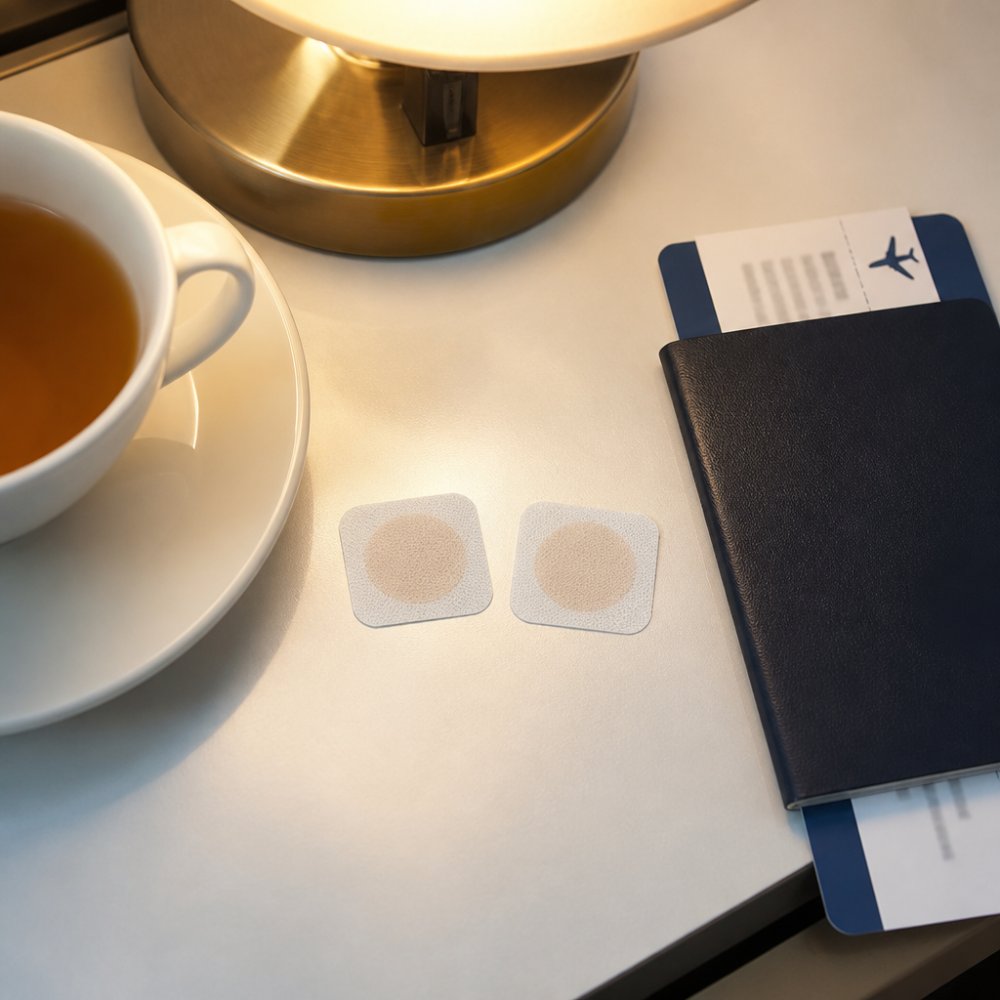
Ingredient lists matter more than marketing copy on a calming patch. A patch sits against your skin for hours, so what is in the adhesive layer is the whole product. The problem is that neither Laki Naturals nor Soothing Skies publishes a stable, full ingredient panel across every retailer page, so the only honest comparison is a method for reading whatever label you are actually holding.
The Ingredient Categories You Will See
Calming patches in this category draw from a small, repeating set of ingredients. Knowing the category tells you what to look for on the panel:
- Botanical extracts, valerian root, chamomile, passionflower, lemon balm, lavender. These are the most common sleep-and-calm actives in topical and aromatherapy products.
- Essential oils, lavender, bergamot, and chamomile oils appear most often. In a patch, the oil is usually carried in the adhesive or a gel layer rather than diffused into the air.
- Magnesium, magnesium chloride or magnesium sulfate, marketed for muscle relaxation and skin absorption.
Laki Naturals: What the Label Tells You
Laki Naturals describes its patches as a natural, plant-forward calming option and leans on botanical extracts in its messaging. What its listings typically do not do is name a dosage per patch or confirm whether CBD is present.
When you open a Laki Naturals listing, look for four things in order: an ingredient panel (not a marketing name), the milligram or percentage of each active, a wear-time statement, and an allergen or skin-sensitivity note.
Soothing Skies: What the Label Tells You
Soothing Skies positions its patch around sleep support and in-flight relaxation, with listings that emphasize calming botanicals and a sleep-focused blend. The same four-item check applies. A short, fully named ingredient list is easier to trust than a long list of unnamed extracts, because unnamed extracts cannot be dosed, compared, or checked against your own sensitivities.
How to Compare Two Patches in Five Minutes
- Photograph both ingredient panels side by side.
- Circle every active that is named with an amount. Ignore anything listed only as "blend" or "extract."
- Note the wear time on each. A patch labeled for 8 hours is not interchangeable with one labeled for 12.
- Check for overlapping actives, if both contain melatonin or magnesium, you are doubling up, not choosing between them.
- Check the allergen line for adhesives, latex, or fragrance, which cause more patch reactions than the actives themselves.
The patch with more named, dosed ingredients wins the comparison, regardless of which brand logo is on the box.
FDA guidance on topical drug products
Natural Sleep Aids for Travel: Where These Patches Fit
Natural sleep aids for travel fall into a few loose groups: oral supplements, aromatherapy, and topical patches. Patches sit in the topical group, which is why travelers who dislike pills gravitate toward them.
A patch does not need to be swallowed, does not require water, and does not wear off the moment you finish a cup of tea.
Where patches fit best is as one part of a routine, not a standalone fix. The CDC guidance on jet lag and travel sleep is a useful starting point for building that routine around your flight schedule.
Sleep Patches for Travel: How to Use Them on a Flight
Sleep patches for travel work best when you apply them at the right moment, not the moment you feel tired. On a long-haul flight, timing the patch to your destination's night is more useful than timing it to your own fatigue.
Applying these patches effectively creates a baseline of relaxation that can be further deepened by the gentle pressure of a weighted sleep mask to ensure a restful journey.Timing, Placement, and Skin Preparation
Apply the patch to clean, dry skin on the upper arm, shoulder, or behind the ear, depending on the brand's instructions. Avoid broken skin, and rotate placement between nights to reduce irritation.
- Apply 30 to 60 minutes before you want to sleep, not at takeoff
- Clean and dry the skin first; oils and lotion weaken adhesion
- Press firmly for 10 to 15 seconds along the edges
If you are flying east, set your patch timing to the destination's bedtime, not the departure city's. That single adjustment does more than any ingredient swap.
Non Habit Forming Sleep Aids: What the Label Doesn't Tell You
Non habit forming sleep aids are usually defined by what they do not contain: no melatonin, no prescription sedatives, no caffeine. A topical patch with botanical extracts fits that description on paper.
The label still leaves gaps. "Non habit forming" is a marketing phrase, not a regulated claim, so it tells you nothing about dosage, absorption, or how the patch interacts with anything else you take.
Here is what we would ask instead:
- Does the label list every active ingredient and its amount?
- Does it state a maximum wear time?
- Does it warn about skin sensitivity or sun exposure?
If a brand answers all four, it has earned more trust than a patch that only claims to be natural.
Price, Pack Size, and Cost Per Use: A Realistic Breakdown
Price per use is the number that actually matters, and it is the number most listings hide. A pack that looks cheap at checkout can cost more per night than a larger pack from a brand that publishes its quantities clearly. Because both Laki Naturals and Soothing Skies change prices and pack sizes frequently, we do not print a fixed dollar figure here, we give you the method, a worked example, and the exact inputs to pull from the live listing.
The Three Inputs
Cost per use = pack price ÷ patch count. That is the whole formula. Everything else is context:
- Pack price, the current checkout price, including any shipping.
- Patch count, the number of patches in the pack, not the number of nights the brand claims.
- Nights you actually travel, your real annual travel nights, not a hypothetical.
A Worked Example
Suppose a 30-patch pack lists at $30 and a 10-patch pack lists at $15. The 30-pack is $1.00 per patch; the 10-pack is $1.50 per patch. If you fly 12 nights a year, the 30-pack leaves you 18 unused patches, and if the shelf life is 18 months, you may not use them before they expire.
Run the same math on the other brand before you decide. The brand with the lower cost per use only wins if you will actually use the patches.
Matching Pack Size to Trip Type
| Trip Type | Patches Needed | What to Compare |
|---|---|---|
| Weekend trip | 2 to 3 | Pack size vs. leftover patches |
| One-week international trip | 7 to 10 | Cost per night, not pack price |
| Twice-monthly business travel | 20+ | Bulk pricing and shelf life |
What to Pull From Each Listing
Before you buy either brand, open both listings in separate tabs and record four numbers: pack price, patch count, stated wear time, and shelf life or expiration date. Divide price by count for each.
We do not publish competitor prices here because listings change and pack sizes vary. Check the current listing, divide price by patch count, and compare that number across brands.
Safety, Skin Sensitivity, and Medication Considerations
Safety comes down to three things: your skin, your medications, and the label's honesty. A patch is a topical product, so the most common issue is local irritation, not a systemic effect.
If you have sensitive skin, patch-test on your inner forearm a day before you fly. The FDA guidance on topical drug products explains how skin-applied products are regulated, which helps you read a label critically.
None of this is a reason to avoid patches. It is a reason to read the panel instead of the tagline.
Which Patch Suits Which Traveler? A Decision Framework
Which patch suits you depends on your trip length, your skin, and how much label detail you can verify. Use this framework:
- Occasional leisure traveler: Start with a small pack and a single patch per travel night.
- Frequent business traveler: Compare cost per use across pack sizes and prioritize brands with full ingredient panels.
- Sleep-focused traveler: Look for a patch that states its sleep-support ingredients and wear time.
For travelers who want a day-and-night protocol rather than a single patch, Reset Jet Lag offers a time-released transdermal system with plant-based ingredients and vitamins, no pills and no caffeine. It is non-habit forming and built around supporting your natural body rhythm across a trip.
When a Patch Isn't the Right Answer
A patch is not the right tool if you have an active skin condition at the application site, if a pharmacist has advised against topical products for you, or if your jet lag is driven mainly by dehydration and poor sleep habits rather than time-zone shift.
For everyone else, the decision comes back to the label. Laki Naturals and Soothing Skies both sell a calming patch. The one worth buying is the one that tells you exactly what is inside it.
Frequently Asked Questions
What is the difference between Laki Naturals and Soothing Skies?
Both sell transdermal patches marketed for calm and sleep support, but they differ in ingredient lists, pack sizes, and positioning. Laki Naturals leans on botanical extracts and magnesium chloride in its topical line, while Soothing Skies markets aromatherapy-style patches. Because neither label is fully standardized, the practical difference comes down to which active ingredients you can verify, how many patches you get per pack, and how long each patch lasts. Read both labels side by side before deciding.
Are Laki Naturals and Soothing Skies products non-habit-forming?
Neither brand uses melatonin or prescription sleep medication in its standard patch line, which is why both can be described as non habit forming sleep aids. That said, "non habit forming" refers to the absence of dependence-forming compounds, not a guarantee of effectiveness. If you have relied on sleep aids before and built tolerance, a patch without those compounds is a reasonable swap. Check the current label for each product, since formulations can change between batches.
How do travel sleep patches compare to melatonin or pills for jet lag?
Patches deliver ingredients gradually through the skin over several hours, while pills release everything at once. For travel, that difference matters: a slow release may support in-flight comfort without the grogginess some travelers report after melatonin. Patches are also easier to pack and use without water. They are not a replacement for timing your light exposure and sleep schedule, but they can be part of a calming routine alongside breathing exercises and a consistent bedtime in the new time zone.
How should you compare the price and pack size of these patches?
Divide the total pack price by the number of patches to get cost per use, then factor in how many patches a typical trip needs. A five-patch pack that covers one round trip is not the same value as a twenty-patch pack you use over several months. Also check whether the brand sells a starter or sample size, because trying one patch before committing to a bulk order is the cheapest way to test skin tolerance and personal response.
Jet lag costs real days, and picking between two similar-looking patches should not be the hard part. Reset Jet Lag was built for travelers who want a clear, non-habit-forming option: a time-released transdermal patch system, a day-and-night protocol, and plant-based ingredients with no pills or caffeine. Get started with Reset Jet Lag and keep your first day at your destination.