

Table of Contents
- How Long Does Jet Lag Last and What Makes It Worse
- Non-Habit Forming Sleep Aids That Travelers Can Trust
- Why a Transdermal Patch for Travel Beats Pills and Powders
- What to Look For When You Buy Natural Jet Lag Support
- Pre-Flight Timeline: When to Buy Natural Jet Lag Support and Start Using It
- Age-Specific Jet Lag Support for Kids, Adults, and Older Travelers
- Contraindications, Drug Interactions, and Skin Sensitivity Checks
- Conclusion
- Frequently Asked Questions
Last Updated: September 25, 2026
How Long Does Jet Lag Last and What Makes It Worse
Jet lag typically lasts one day for every time zone crossed, though most travelers feel noticeably better within three to five days. A flight from New York to Tokyo crosses 13 zones, so a full adjustment can stretch nearly two weeks. That timeline is why so many business travelers lose their first two working days abroad.

The circadian rhythm governs your sleep-wake cycle, hormone release, and body temperature. When you fly east, you force that internal clock to run ahead of schedule, which is why eastbound trips hit harder than westbound ones for most people. According to the CDC Yellow Book chapter on jet lag, the direction of travel and number of zones crossed are the two biggest predictors of symptom severity.
What makes it worse:
- Alcohol and caffeine during the flight, which disrupt sleep latency and hydration status
- Dehydration from dry cabin air
- Eating heavy meals at the wrong local time
- Arriving and immediately napping for hours
Travel fatigue compounds all of this. The fix is not one product. It is a recovery protocol that starts before you board.
Non-Habit Forming Sleep Aids That Travelers Can Trust
"Non-habit forming" means the product does not create dependence or tolerance, you do not need escalating amounts to get the same effect, and stopping does not trigger withdrawal. That distinction matters for anyone who flies more than a few times a year, because the last thing you want is a sleep aid that becomes its own problem.
The category most travelers end up choosing from includes four main options:
- Melatonin, a hormone your pineal gland already produces to signal darkness. Taken at the right local time, it nudges your circadian rhythm toward your destination's schedule. It is the most studied option for shifting the sleep-wake cycle, and it has genuine sedative properties at the right dose. Timing matters more than total amount: taken too early or too late, it can push your clock the wrong direction.
- Magnesium, a mineral involved in muscle relaxation and nervous-system regulation. It does not knock you out, but it supports the wind-down state that makes sleep easier to fall into. Common forms include magnesium glycinate (often chosen for evening use) and magnesium citrate (more often used for digestion).
- Valerian root, a plant with a long history as a sleep aid. Effects vary noticeably between people, and it is often paired with hops or lemon balm in evening formulas.
- Transdermal delivery systems, patches that release ingredients slowly through the skin rather than in one spike.
The NIH National Center for Complementary and Integrative Health overview of melatonin notes that timing and dosage guidelines matter more than the specific product you choose. That is the part most buying guides skip.
What most guides miss: tolerance is less about the ingredient and more about the delivery method. A pill delivers one spike, which can leave you groggy if it lands at the wrong point in your sleep cycle. A transdermal patch for travel delivers a steadier dose over several hours, which some travelers find easier on the body and less likely to produce that heavy, drugged feeling on arrival.
The other thing to check is whether the formula separates day and night. A single "sleep patch" used around the clock does not match how your body actually works, you want stimulation support during daylight hours and calming support at local bedtime, not the same blend for both.
Why a Transdermal Patch for Travel Beats Pills and Powders
A transdermal patch delivers ingredients through the skin over several hours rather than in a single dose. For travelers, that steady release is the whole point: no pill to swallow on a cramped flight, no powder to mix, and no caffeine crash.
Pills and powders have real drawbacks on the road. You need water, you need timing discipline, and a single dose can hit all at once. A patch removes most of that friction. You apply it, wear it for up to 8 hours, and remove it.
Reset Jet Lag built its system around this idea. The Reset Jet Lag Travel Patch System uses a day-and-night protocol: a Day Patch with B-complex vitamins, Vitamin C, and Vitamin E, and a Night Patch with melatonin, magnesium, hops, and valerian root. Each patch is 30mm x 30mm, ultra-thin, and discreet under clothing. One resealable pouch holds 12 patches (6 Day + 6 Night) for $21.99.

That structure is why we treat it as the top pick for travelers who want a non-habit forming option without pills or caffeine.
Reset Jet Lag Travel Patch System - 1 →
What to Look For When You Buy Natural Jet Lag Support
When you buy natural jet lag support, check four things before you pay: ingredient transparency, delivery method, dosage guidelines, and whether the product is habit forming.
Run through this checklist:
- Full ingredient list published, not just "proprietary blend"
- Clear dosage guidelines and wear time per patch or dose
- Non-habit forming claim you can verify against the ingredient list
- Medical-grade, hypoallergenic adhesive if you have sensitive skin
- Day and night formulas separated, not one patch for both
- Patch size and wear duration stated
A product that hides its ingredient amounts is a product you cannot evaluate. Skip it.
Pre-Flight Timeline: When to Buy Natural Jet Lag Support and Start Using It
Start your protocol two to three days before departure, not the morning of your flight. Buying early gives you time to test the patch at home and adjust your sleep schedule toward your destination's time zone.
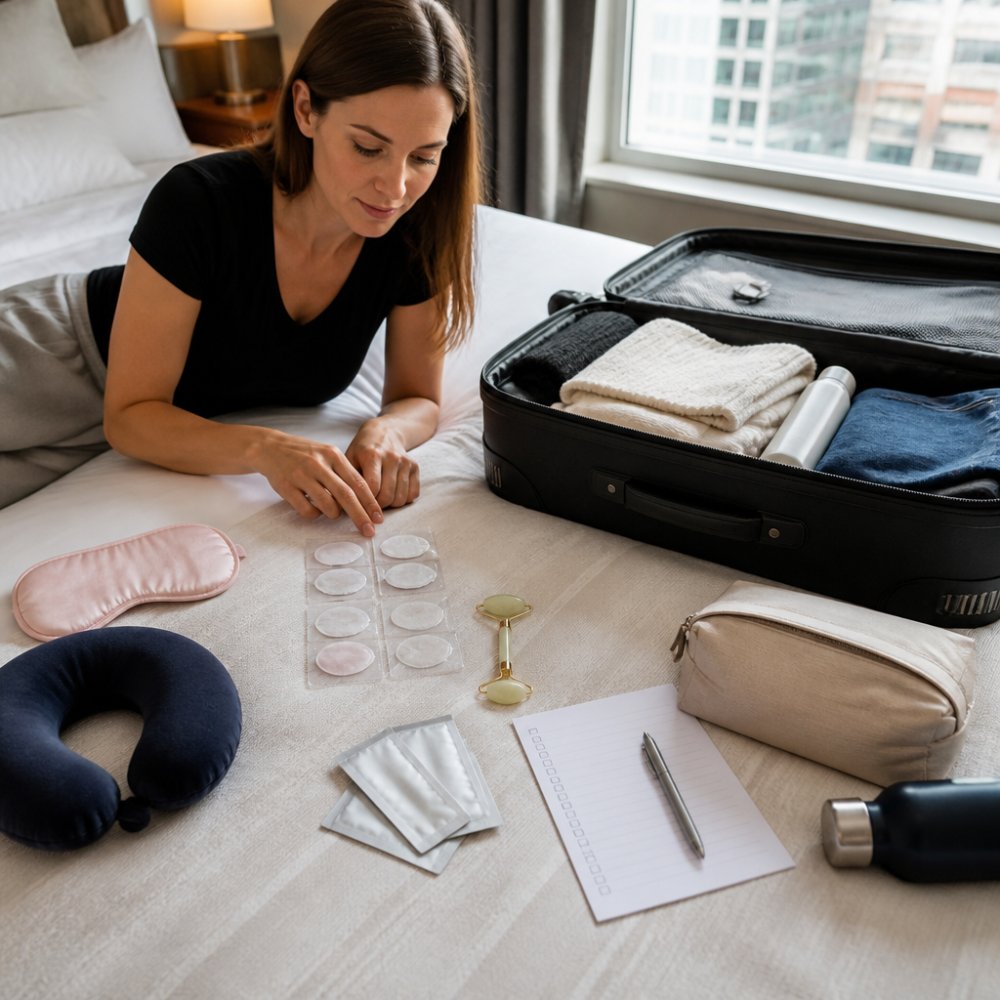
Here is a simple pre-flight schedule:
| When | Action |
|---|---|
| 3 days before | Buy your patches and hydration mix; shift bedtime 30-60 minutes toward destination time |
| 2 days before | Test one patch at home; increase daytime sunlight exposure |
| Day before | Pack patches and electrolyte sticks; hydrate well; avoid late caffeine |
| Flight day | Apply Day Patch in the morning; hydrate with an electrolyte mix |
| First night abroad | Apply Night Patch before local bedtime |
Strategic sunlight exposure is the free half of this protocol. Morning light at your destination resets your internal clock faster than almost anything else.
Age-Specific Jet Lag Support for Kids, Adults, and Older Travelers
Jet lag support should change with age, because sleep needs, circadian flexibility, and sensitivity to melatonin all shift across the lifespan. A patch protocol that suits a 40-year-old business traveler may not suit a 7-year-old or a 70-year-old. Most jet lag guides ignore age entirely, that is the gap this section closes.
Contraindications, Drug Interactions, and Skin Sensitivity Checks
Check with a healthcare provider before using any jet lag supplement if you take medication, are pregnant, or have a chronic condition. Melatonin and valerian root can interact with sedatives, blood thinners, and some antidepressants.
Conclusion
Jet lag steals the days you paid to enjoy or the meetings you flew to win. A structured protocol, started before departure, protects both. Reset Jet Lag makes that easy with a time-released transdermal patch system, a separate Day and Night formula, and plant-based ingredients with no pills or caffeine. Rated 4.7/5 by more than 4,000 travelers, the system helps your body adjust faster and keeps your energy and focus intact on arrival.
Frequently Asked Questions
What is the best supplement for jet lag?
There is no single best supplement for everyone. Night formulas often combine melatonin with magnesium, hops, and valerian root to support sleep latency, while day formulas rely on B-complex vitamins and vitamin C. A transdermal patch for travel delivers these ingredients gradually through the skin, which some travelers prefer over swallowing pills. Look for third-party testing, clear dosage guidelines, and a non-habit forming design before you buy natural jet lag support.
Do jet lag supplements really work?
Results vary by person, route, and routine. Ingredients such as melatonin, magnesium, and valerian root are widely used to support the sleep-wake cycle, and adaptogens like ashwagandha are popular for travel stress. Supplements work best alongside light exposure, hydration, and caffeine timing rather than replacing them. If you want to buy natural jet lag support, treat it as one part of a broader recovery protocol, not a standalone fix.
How do non-habit forming sleep aids work for travelers?
Non-habit forming sleep aids support the body's natural wind-down process without creating dependence. Options include magnesium, valerian root, hops, lavender, and low-dose melatonin, often delivered through a patch so the dose releases slowly over about eight hours. Because they do not rely on sedative drugs, they are easier to stop after a trip. Pair them with sleep hygiene basics like a dark room and a consistent bedtime to reinforce your internal clock.
Are transdermal patches effective for jet lag?
Transdermal patches deliver ingredients through the skin over several hours, which can provide a steadier release than a single pill. For jet lag, that means a night patch can support sleep through the night and a day patch can support focus without caffeine. Effectiveness still depends on timing, hydration, and light exposure. Apply to clean, dry skin free of lotion, and wear each patch for up to eight hours as directed.